Monthly Reading Log Printable: How to Use One
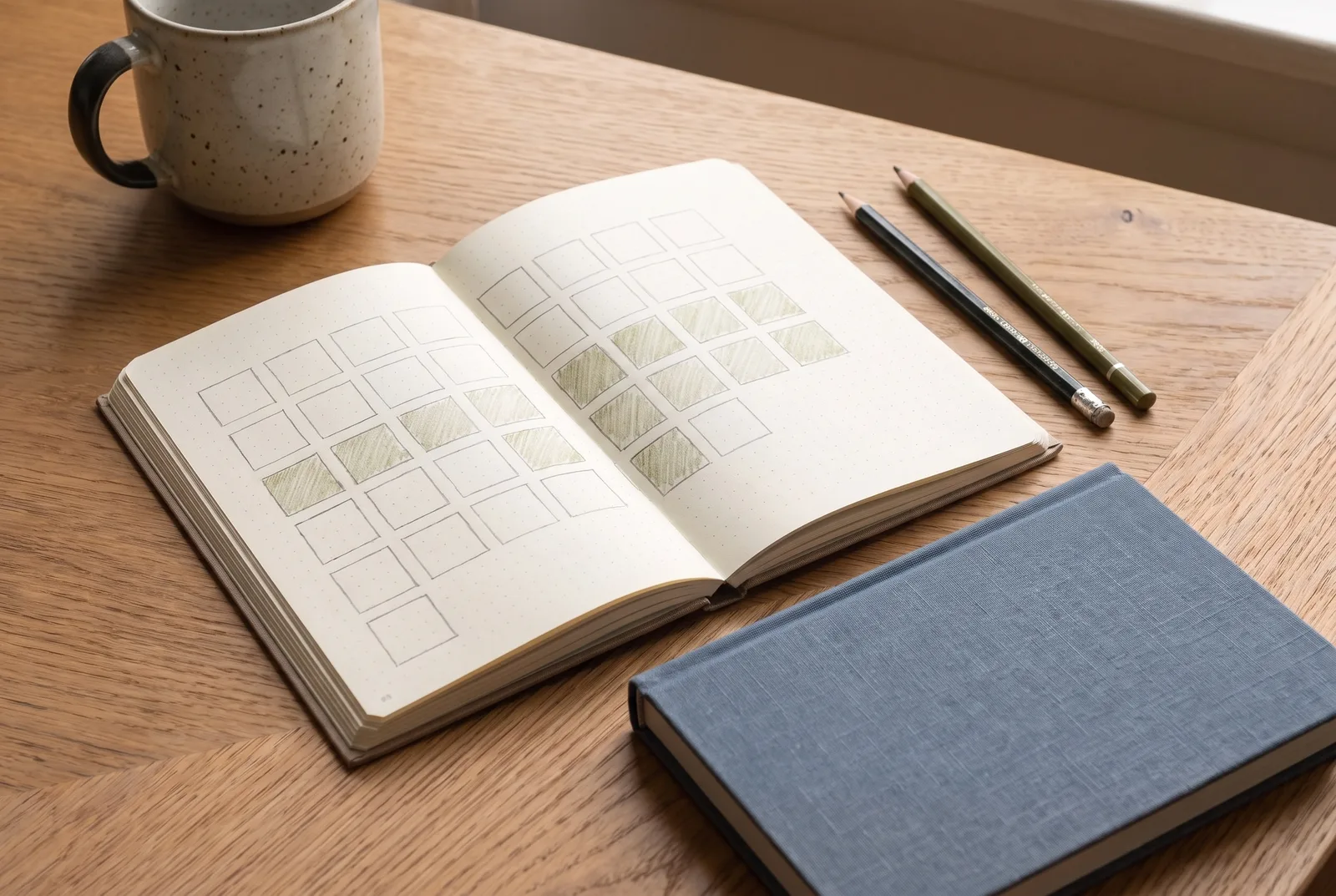
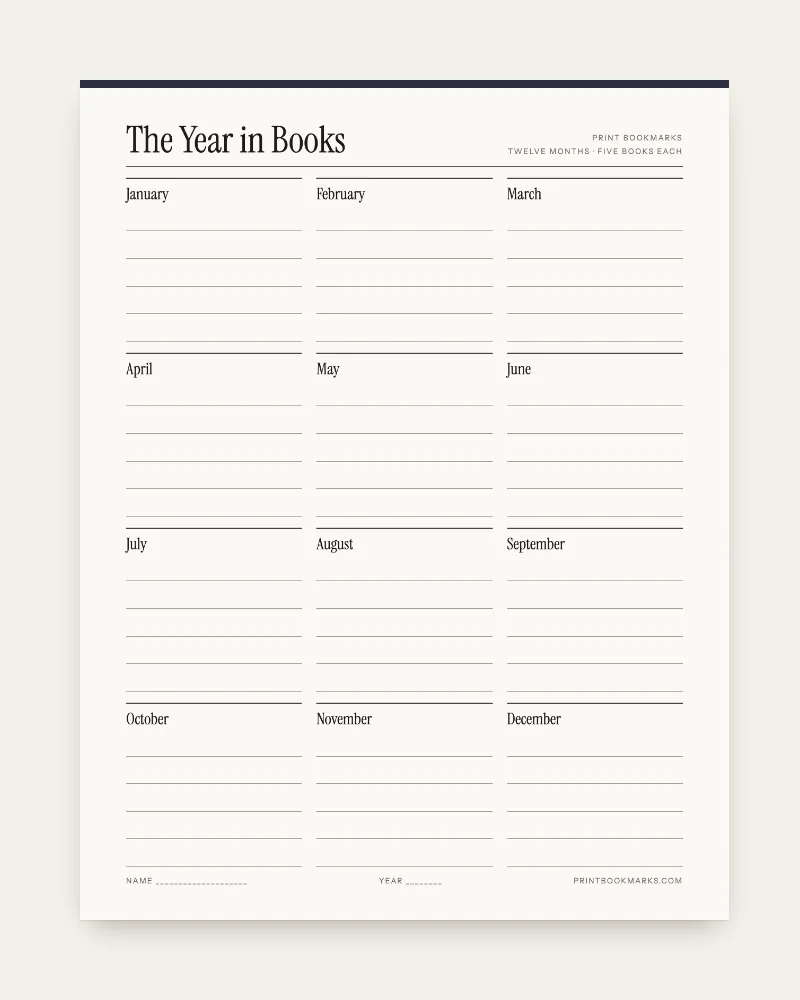
Some months you finish three books and some months you finish none. A monthly reading log printable is a single page for one month of reading. You set it up yourself, by hand or printed from your own layout, with a grid of days and room for the books you start and finish. The Year in Books, our sheet, holds the finished titles for the whole year.
Why a Monthly Reading Log Works for Adults
A month is long enough to show a pattern and short enough to remember. A week often ends in the middle of a book, and a year is too long to look back over in one sitting. One page per month sits between the two.
Adult reading also happens in small amounts. The U.S. Bureau of Labor Statistics reports that Americans over age 14 spent about 17 minutes on an average day in 2024 reading for personal interest. The American Academy of Arts and Sciences used the same federal survey. It found that 14.6% of Americans age 15 and older read more than 20 minutes on an average day in 2023. When the daily amounts are that modest, a page of days shows progress that a tally of finished books would miss.
Step 1: Set Up the Month Page
Head the page with the month and give it four zones. It fits on one sheet. A grid of days holds the daily amounts. Two short lists hold the books you started and finished, and a small box holds your month-end notes. You can draw this on a sheet of plain paper with a ruler.
| Zone | What to write | Why it helps |
|---|---|---|
| Day grid | Pages or minutes read, or a dot | Shows which days you read at all |
| Books started | Title and the date you began | Reminds you what is in progress |
| Books finished | Title, date and a star rating | Gives the month its headline |
| Mood or note | One word or one line | Records how reading felt that month |
Step 2: Choose Pages or Minutes
Pick one unit for the whole month. Write it at the top of the page. Choose once. Pages suit print and e-book readers who can see a page number. Minutes suit listeners and anyone who reads across formats.
Commit to one unit because pages and minutes cannot be added together. A mixed column ends in a total that means nothing.
Pro Tip: Write the unit in the top corner of the month page before you fill in day one. If you move between print and audio, choose minutes, since an audiobook has no page numbers.
Step 3: Decide Between Daily and Monthly Tracking
Daily tracking suits you when you want to read more often. Monthly tracking suits you when you want to see the shape of your reading. Most readers do best with a month page that has a light daily mark. Dots count. A dot is enough on busy days, and a number is enough on the days you read a lot.
| Question | Daily reading tracker | Monthly reading log |
|---|---|---|
| Best for | Building a reading habit | Seeing patterns and finished books |
| Effort | A mark every day | A few entries a month |
| Main risk | An empty box feels like failure | Gaps stay invisible until month end |
| Good moment to use it | A month when you want to read more | Any month, including slow ones |
If you read in bursts, the monthly view is kinder. A weekend of three hundred pages and a week of none still add up to a month you can read at a glance.
Step 4: Count Each Book Once, in the Month You Finish It
Count each book once, in the month you finish it. The started list only reminds you what is in progress. Nothing is counted twice. The month page then answers what you read, and a list across months answers how the year went.
Use a page per month for the day grid and one twelve-month sheet for the titles. The Year in Books, our one-sheet list, has twelve months with five lines each in US Letter and A4 for $4.00. Print it at actual size on plain or matte paper around 120 gsm, and write each finished title under its month.
For the full-year view, see our guide to tracking the books you read this year. It compares four formats for the year, so you can match your month pages to it.
How to Set a Realistic Monthly Target
Base the target on what you actually read, not on a hopeful number. It stays honest that way. Add up the books you finished in the last three months, divide by three and round up. If you finished 2, 1 and 4 books, the total is 7, which divided by three is 2.3, so your target is 3 books.
The same method works for pages or minutes. Add up the last three month totals, divide by three and round up. If a month falls short, your next target stays the same, and it only rises when you beat it for a few months.
Step 5: Do a Month-End Review in Five Questions
At the end of the month, add up the day grid and write three totals at the bottom of the page. Count the books finished, the pages or minutes read and the average star rating. Then answer five questions about the month. Be brief, one sentence each, on the back of the page or in the note box.
- Which books did I finish or stop?
- Was my pace up or down from last month?
- On which days did I read the most?
- What got in the way of reading?
- What goes on next month's list?
A stopped book goes in the answer to the first question, with the page you stopped at and one line on why. The second and fourth answers matter most over time. They show whether your reading follows the calendar and what you could change.
Key Takeaway: A month page works because it ends. Close the month with five answers, then start the next one with an empty grid.
When The Year in Books Is Not Enough
The Year in Books lists titles by month. It has no day boxes. If you want a day-by-day grid of pages or minutes, draw one in a notebook using the layout above. A notebook is also the better home for a month-end review that runs longer than a few lines.
Overview of the Five Steps
| Step | What you do | What it gives you |
|---|---|---|
| 1 | Draw a day grid, two book lists and a note box | A month page that fits on one sheet |
| 2 | Choose pages or minutes for the month | Daily numbers you can add up |
| 3 | Mark days lightly, and decide how much daily tracking you want | A habit view without the pressure |
| 4 | Count each finished book once, under its month | A year of titles in one place |
| 5 | Answer five questions at month end | A short review you can compare month to month |
FAQ
What is a monthly reading log?
A monthly reading log is one page for one month of reading. It records the books you started and finished, how much you read on each day and a short note on how the month went.
Should I track my reading daily or monthly?
Track daily if you want to build the habit, and monthly if you want to see patterns and finished books. A month page with a light daily mark gives you both without much effort.
What should a monthly reading log include?
Include a grid of days for pages or minutes and a list of books started. Add a list of books finished with ratings and a few lines of notes. Choose one unit for the month so the daily numbers can be added.
What do I get with The Year in Books, and can I print it again?
You get a zip with a US Letter PDF, an A4 PDF and a README, and a receipt email brings the download link right after payment. Print it at actual size (100%) on plain or matte paper around 120 gsm. You may print as often as you like for you and your household, and give printed bookmarks or sheets as gifts. Please do not share or resell the file.
Conclusion
A month is a good size for a reading log. Set up a day grid and two short lists, pick pages or minutes, mark your days lightly and list every finished book under its month. Five questions at month end turn the page into something you learn from. Draw your first month page today.
Sources
- U.S. Bureau of Labor Statistics, It's Read Across America Day! The Economics Daily (2026) (last checked 2026-10-05)
- American Academy of Arts and Sciences, Time Spent Reading, Humanities Indicators (n.d.) (last checked 2026-10-05)