Yearly Reading Tracker: A Step-by-Step Guide
By December you may not remember whether you read twelve books or twenty. A yearly reading tracker is a record of every book you finish between January and December. You build one by choosing what to count, setting a goal and picking a format you will update.
Step 1: Decide What to Count
Pick one unit before you buy or draw anything, because the unit decides which tracker fits. Books are the simplest. Pages and minutes treat a long book and a short one fairly.
| Unit | Works well for | Weak spot |
|---|---|---|
| Books finished | Most readers, and any format | A 900-page novel counts the same as a novella |
| Pages | Readers of long books | Audiobooks have no pages |
| Minutes | Busy weeks and audiobooks | Needs a note after every sitting |
| Books and a verdict | Readers who want to remember each one | More to write at every last page |
Most readers do well with books finished, since a count is hard to get wrong. Add a second unit only if the first one frustrates you.
Decide whether audiobooks count. Many readers count them as books because the story is finished either way, and others keep a separate tally. Both choices are fine. Write yours on the tracker so a year-end total means the same thing as the one before.
Write down your counting rules at the same time. Does a re-read count, or a book you abandoned at page 100, or a short story collection read in pieces? Goodreads says on its Reading Challenge page that re-reads count toward your goal. You can adopt that rule or write your own, as long as you write it on the tracker.
Step 2: Set a Goal and Mark the Halfway Point
Take your goal from last year's total and keep the choosing short. Our reading challenge ideas cover goals and formats in full. The tracker's job is to show pace, and a Pew Research Center survey from October 2025 gives a sense of scale. Pew Research Center reports that 25% of U.S. adults had read no books in the past 12 months and 38% had read one to five, so the median reader falls in the one-to-five bracket.
Once you have a number, translate it into a pace you can check against your tracker.
| Yearly goal | Per month | Per week | Halfway mark |
|---|---|---|---|
| 12 books | 1 | 1 every 4 to 5 weeks | 6 books by the end of June |
| 24 books | 2 | 1 every 2 weeks | 12 books by the end of June |
| 52 books | About 4 | 1 | 26 books by the end of June |
| 100 books | About 8 | About 2 | 50 books by the end of June |
Pro Tip: Mark the halfway point on your tracker in advance. If your goal is 20 books, draw a line after book 10 and see which month you reach it. Reaching it before July means you can raise the goal, and a late arrival tells you to lower it without shame.
Step 3: Choose Where Your Yearly Reading Tracker Lives
The best tracker is the one in the place where you finish books. Four formats cover most readers, and each suits a different habit.
| Format | Good for | Limit |
|---|---|---|
| Bookmark | Updating at the last page, since it sits in the book | Small, so it holds a count more than notes |
| One printed sheet | A year at a glance on the wall or in a binder | Fixed number of lines |
| Journal spread | Readers who also write about each book | No count unless you make one |
| App | Automatic counts, charts and reminders | Lives on a phone, with an account |
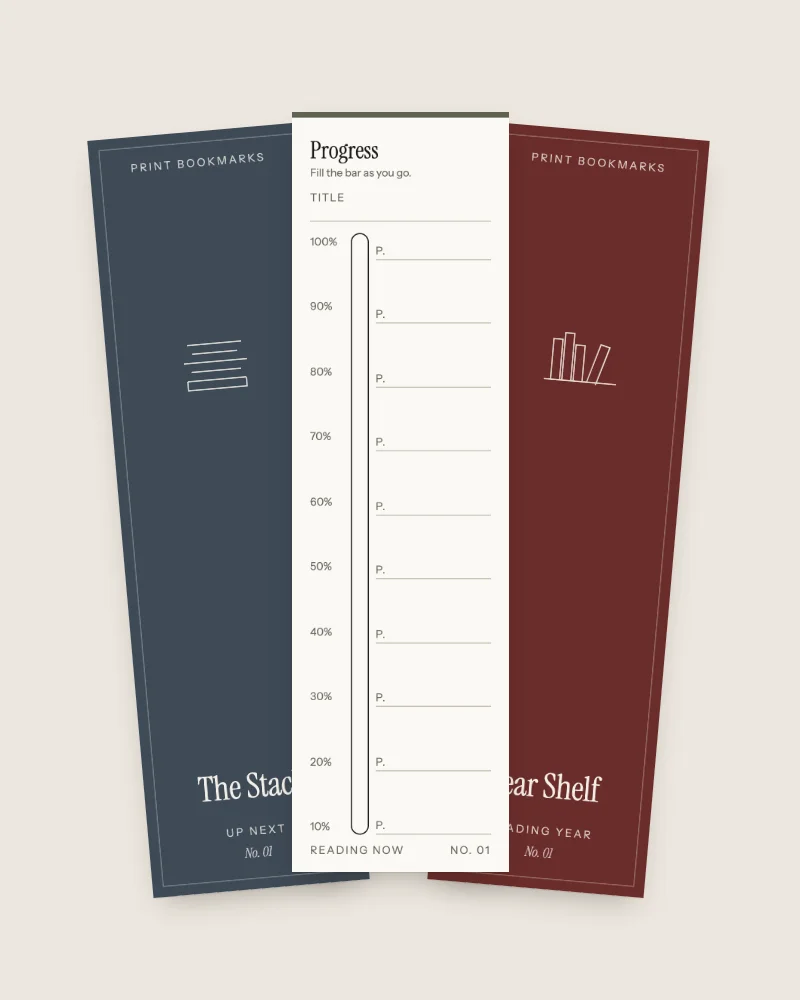
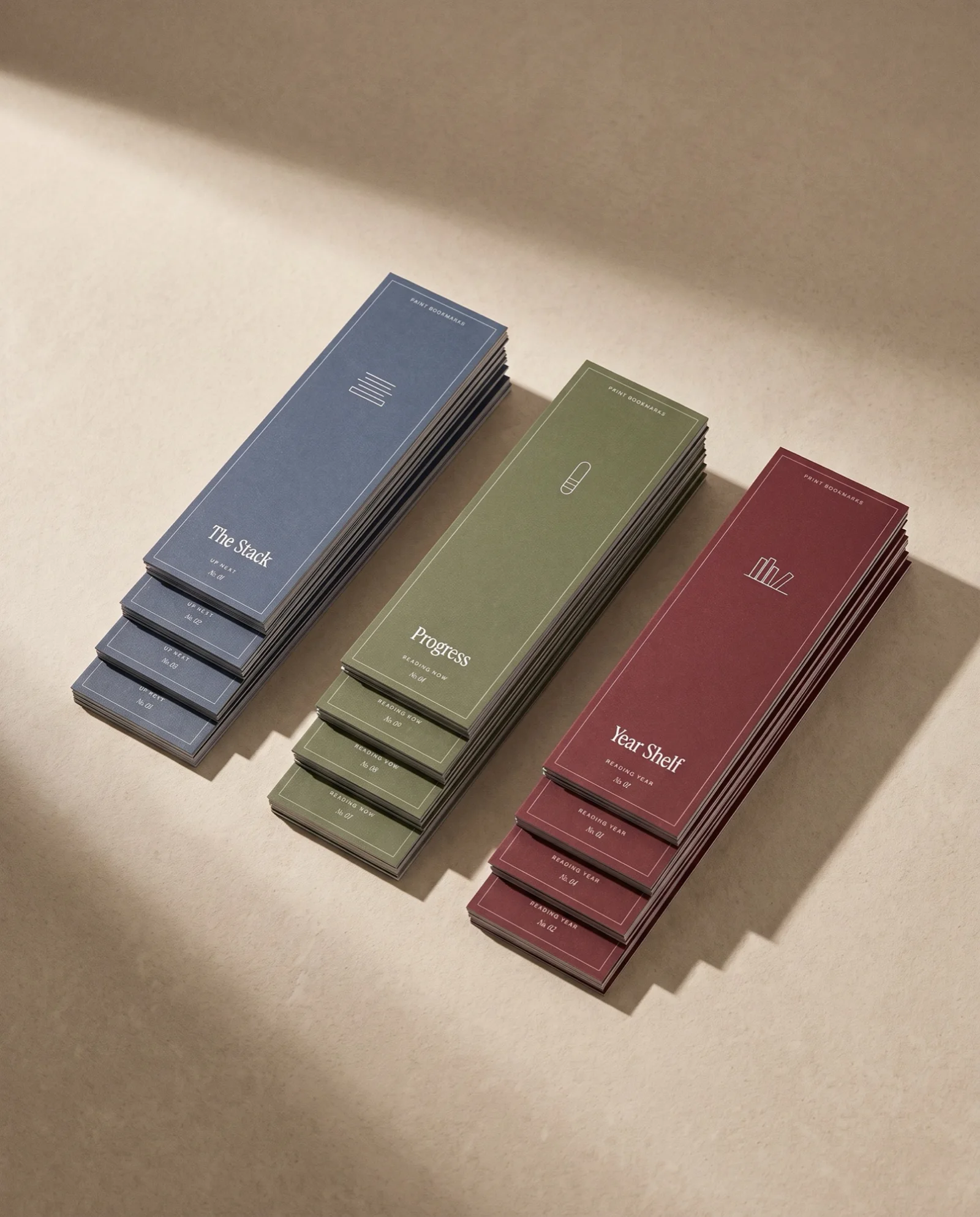
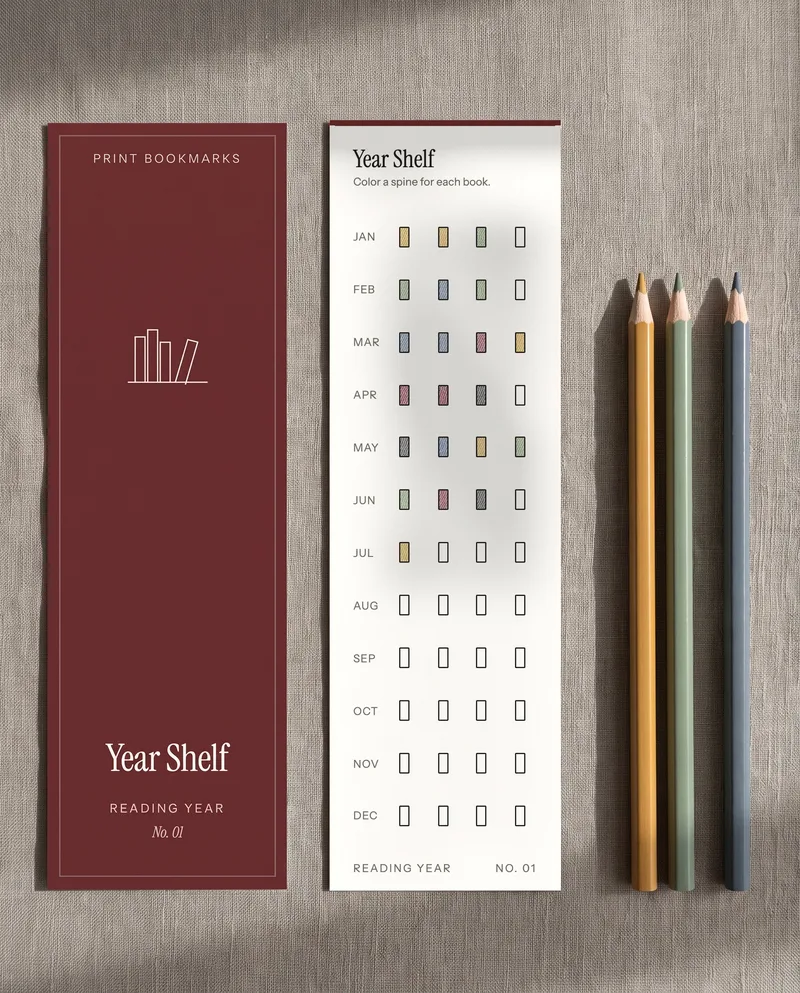
A bookmark is the easiest to keep alive. Our Reading Year bookmark set has six. The Goal Jar lets you set a number and fill one circle per book. Year Shelf has a spine to color for each book, month by month. Finished is a numbered list of titles. The set also holds a Challenge bookmark with twelve prompts and a By Kind bookmark with a stroke per book by genre. Best of the Year takes your five favorites. Each trims to 2 by 7 inches.
The Year in Books is a printed sheet with twelve months and five books each, so it holds up to 60 titles. Taped inside a cupboard door or kept in a binder, it gives you the whole year in one place. A reader who finishes more than 60 books needs a second sheet or a different format. Our guide to starting a reading journal shows how to fold a sheet like this into a notebook.
Apps do some jobs better. The Goodreads page says Kindle books count automatically once you link your Amazon account, and a paper tracker will never do that. If you want charts and counts without writing anything, use an app. Our printed trackers count only what you write down.
Paper and an app also work together. Let the app keep the running count, and keep a bookmark in the book for notes at the page. At the last page, write the title on the bookmark and add it to the app. Our comparison of book tracker apps and paper shows how the two fit.
Step 4: Keep the Tracker Going
A tracker survives when updating it is attached to a moment that always happens. For most readers that moment is the last page. Close the book and add the title before you do anything else.
Keep the tracker where the book is. A bookmark sits inside it, and a sheet can live next to your reading chair. A tracker in another room only gets updated in batches, and batches are how books go missing.
When you fall behind, catch up from the evidence. Your shelves, your library account and your e-reader history all show what you finished. Do not reconstruct the year from memory in one sitting. Missing a title costs less than abandoning the tracker.
Falling behind is also a reason to change how you read. Choose shorter books for a stretch, or add an audiobook to the walk or drive you already make, if you count audio. A few short titles can bring a halfway mark back within reach, and a lower goal is always an option.
Step 5: Review the Year in December
A year-end review turns a list into a picture. Spend one sitting with your tracker and answer a few questions, then write the answers on the last page.
- How many books did I finish, and how does that compare with my goal?
- Which months were full, and which were empty?
- Which kind of book did I read most, and which did I skip?
- Which five were the best, and what do they share?
- What number would I choose for next year, and why?
The questions line up with the Reading Year set. The By Kind bookmark answers the third, the Best of the Year bookmark answers the fourth, and Year Shelf answers the second at a glance.
Key Takeaway: A goal is only useful when the tracker shows progress against it. Pick the unit, write the counting rules on the sheet and mark the halfway point, and the December review takes care of itself.
Overview of the Five Steps
| Step | What you do | What you end up with |
|---|---|---|
| 1 | Pick a unit and write the counting rules | A count you can trust |
| 2 | Set a goal from last year's total | A number with a halfway mark |
| 3 | Choose a bookmark, sheet, journal spread or app | A tracker in the right place |
| 4 | Update it at the last page of each book | A habit that survives busy weeks |
| 5 | Answer five questions in December | A review you can use next year |
FAQ
How do I keep track of books read this year?
Write each title down at the last page. Use a bookmark, a printed sheet, a notebook page or an app, and keep it where you finish your books. Count one unit all year.
Is reading 40 books a year a lot?
A 40-book year is more than most adults read. In a Pew Research Center survey from October 2025, 14% of U.S. adults had read more than 20 books in the past 12 months, and 40 books falls in that top group. The goal averages a little over three books a month.
What is the best reading tracker?
The best one is the one you update after every book. Choose an app for automatic counts, a bookmark for updating at the page and a sheet for the year at a glance.
What do I get with Reading Year, and can I print it again?
You get a zip with a US Letter PDF, an A4 PDF and a README, and a receipt email brings the download link right after payment. Print the test sheet on pages 3 and 4 first, then print at actual size (100%) on matte card of about 176 gsm (65 lb cover), flip on the long edge and cut. You may print as often as you like for you and your household, and give printed bookmarks or sheets as gifts. Please do not share or resell the file.
Conclusion
A yearly reading tracker needs a unit, a goal and a place to live. Count books unless you have a reason not to, set the number from last year and keep the tracker where you finish books. In December, answer five questions and write next year's goal on the same page.
Sources
- Pew Research Center, Americans still opt for print books over digital or audio versions; few are in book clubs (2026) (last checked 2026-10-05)
- Goodreads, Join the Goodreads Reading Challenge (2026) (last checked 2026-10-05)