How to Start a Reading Journal

By spring, the books you read over the winter can start to blur together. A reading journal is a notebook where you record what you read and what you made of it, and starting one takes a notebook, a few fixed pages and the habit of writing a little after each book.
What Is a Reading Journal?
Picture a diary kept only for books. A reading log records the facts, such as title, author and the dates you started and finished. A journal keeps those facts and adds your thoughts, the lines you loved and the questions a book left you with.
Writing about a book also helps you understand it. A 2010 report for Carnegie Corporation of New York found that students understood texts better when they wrote about what they read. The practices it names are personal reactions, summaries, notes and written answers to questions about the text. The research looked at school students, yet those four habits make a good menu for any reader's notebook.
Step 1: Choose a Notebook You Will Carry
The right notebook is the one that fits in the bag you take your book in. A journal left on a desk only gets used at the desk. Small and sturdy usually beats large and beautiful.
Lined pages suit readers who mostly write, and dotted pages suit readers who like to draw tables or shelves. Blank pages give you the most freedom and the least structure. Check that your pen does not bleed through, since you will write on both sides. Number the pages before you start. That makes an index possible later.
Step 2: Set Up a Few Fixed Pages First
Before the first book entry, reserve a handful of pages at the front for the things you look up most. An index, a to-read list and a year at a glance cover most needs. Leave the rest for books.
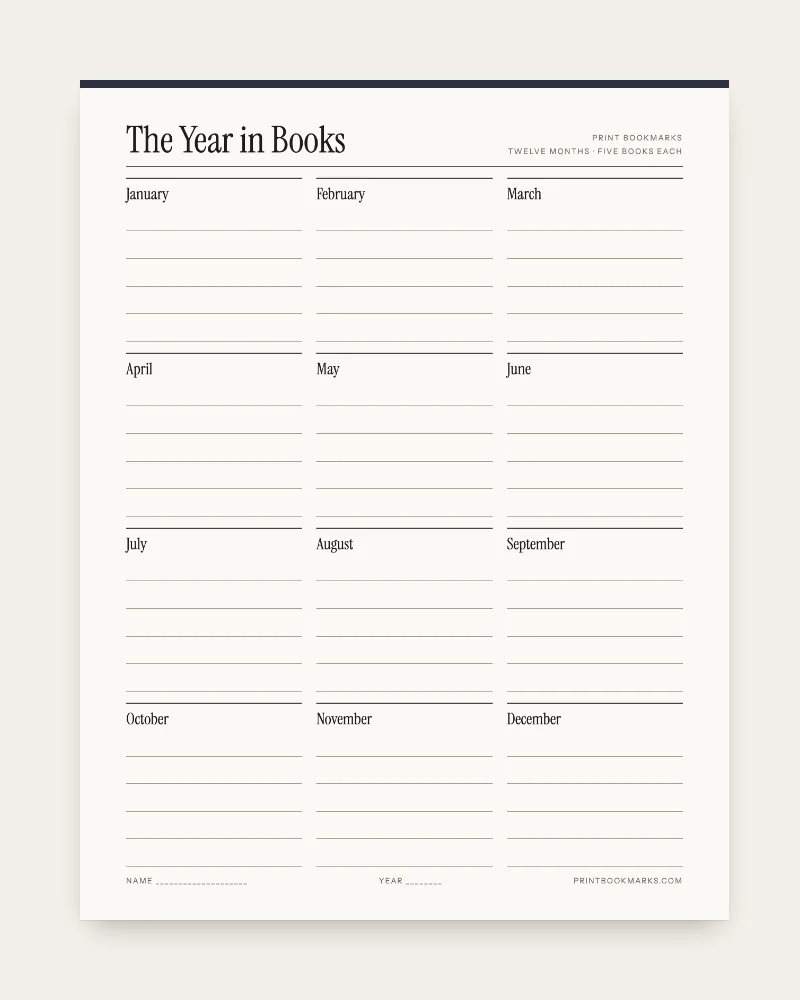
The to-read page works best split into books you own, books you have borrowed and books you still want. Our guide to making a TBR list walks through that setup. The year page can be drawn by hand, or you can fold in a printed one.
The Year in Books, one of our printable reading lists, gives you twelve months with five lines each on a single sheet. Print it, fold it or trim it, and tape it inside the front cover, next to your index, so each finished title gets one line.
Step 3: Give Each Book a Page
One page per book is enough for most readers, and a spread suits the books you want to think about longer. Write the facts at the top when you start. Keep them brief. Add the thoughts below when you finish, from the notes you kept in the book.
| What to record | Example | Why it helps later |
|---|---|---|
| Title and author | The full title, spelled as on the cover | Finds the book again in a library or shop |
| Dates started and finished | March 3 to March 19 | Shows your pace across a year |
| Format | Print, e-book or audio | Explains why you have no page numbers for an audiobook |
| Lines to keep | A sentence and its page number | Lets you quote it correctly |
| Who's who | Names and one fact each | Rescues you in a crowded novel |
| Verdict | One line and a rating | Answers "Was it good?" in a second |
Format deserves its own line, because print is far from the only way people read. In a Pew Research Center survey from October 2025, 64% of U.S. adults said they had read a print book in the past 12 months. E-books came to 31% and audiobooks to 26%, so plenty of journals will mix all three.
Step 4: Take Notes While You Read
Notes made at the page are sharper than notes made from memory a week later. Carry a pencil in the book. Use a slip of paper for lines, names and words. Move the best of them into the journal when you finish.
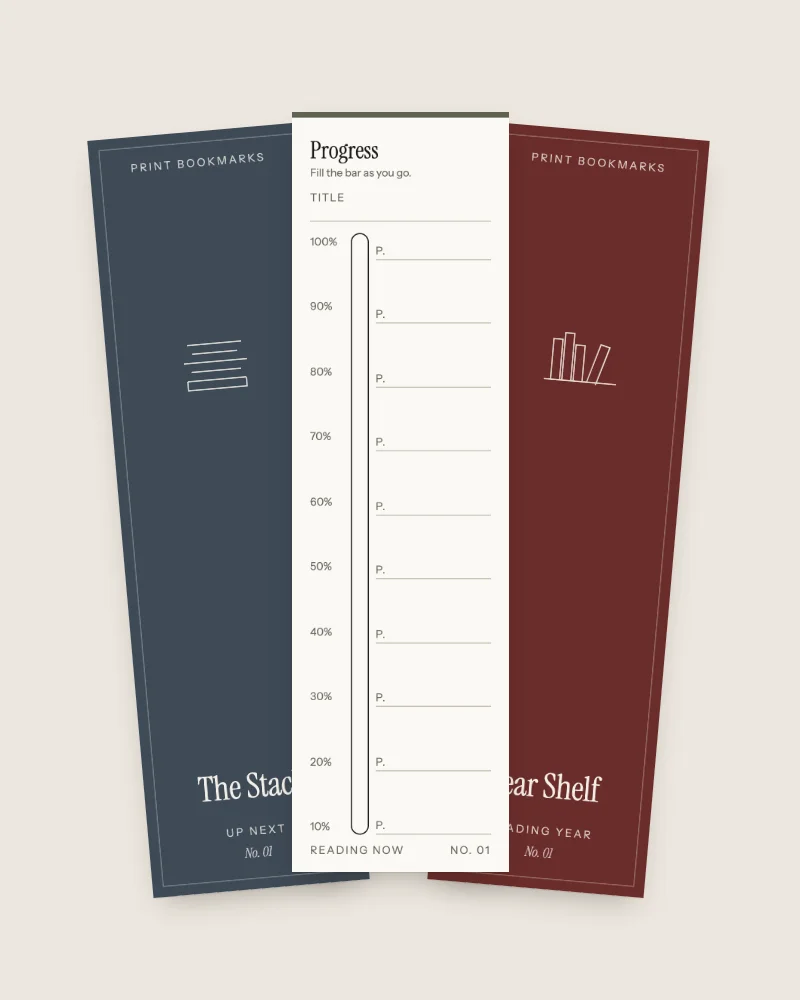
A tracker bookmark can replace the loose slip, with ruled space for lines to keep, characters and words to look up. Our comparison of book tracker apps and paper shows what a bookmark can hold and where an app does better.
Pro Tip: Write the page number first and the quote second. A quote without its page is hard to find again, and the number takes two seconds while the book is still open.
Step 5: Keep the Habit Going
The habit survives when each entry is small and happens at the same moment. The last page of a book is the natural trigger. Close the book, open the journal and write the verdict line before you choose the next one.
Skip a book if you need to, and never backfill a month in one sitting. A gap is fine. Once a month, read back over the latest pages and add a line wherever your view of a book has changed.
Key Takeaway: One line at the last page keeps a journal alive. The longer notes are a bonus for the books that earn them.
Reading Journal Page Ideas
Beyond the book pages, a few themed pages make the journal more fun to flip through. Pick two or three to start with.
- A shelf of spines to color in as you finish each book.
- A quotes page that collects your favorite line from every book.
- A series tracker with every title in order and a box for each.
- A "told to read" page with who recommended each book and whether they were right.
- A did-not-finish page with the page you stopped at and why.
- A book-to-screen page comparing an adaptation with the original.
- A page of challenge prompts, such as those in our list of reading challenge ideas.
- A genre tally with one stroke per book.
When a Notebook Is the Wrong Tool
A paper journal has no search box. For some readers that matters a great deal. If you want to find every book where you mentioned a theme, or share reviews, a digital journal is the better fit. The StoryGraph, for example, lets you record private notes alongside your progress updates. Our printed sheets are the wrong choice for a reader who needs search.
Overview of the Five Steps
| Step | What you do | What it gives you |
|---|---|---|
| 1 | Choose a notebook that travels with your book | A journal that is with you when you read |
| 2 | Set up an index, a to-read page and a year page | Quick answers without flipping every page |
| 3 | Give each book a page with facts and thoughts | A record you can compare across books |
| 4 | Note lines, names and words at the page | Quotes and names you can trust |
| 5 | Write a verdict line at every last page | A habit small enough to keep |
FAQ
What is a reading journal?
A reading journal is a notebook for the books you read. It holds the facts, such as title, author and dates, plus your thoughts, favorite lines and a verdict on each book.
How can I create a reading journal?
Choose a notebook you will carry, reserve a few pages for an index, a to-read list and a year at a glance, then give each book its own page. Write a verdict line whenever you finish a book.
What should I write in my reading journal?
Start with title, author, dates, format and a rating. Then add lines to keep with their page numbers, who's who, words you looked up and one line on what you thought.
What do I get with The Year in Books, and can I print it again?
You get a zip with a US Letter PDF, an A4 PDF and a README, and a receipt email brings the download link right after payment. Print it at actual size (100%) on any home inkjet or laser, on plain or matte paper around 120 gsm. You may print as often as you like for you and your household, and give printed bookmarks or sheets as gifts. Please do not share or resell the file.
Conclusion
A reading journal needs very little to start. Pick a notebook that travels with your book, set up a few fixed pages, give each book a page and write one line at every last page. The more you write about what you read, the more of it stays with you. Start with the next book.
Sources
- Carnegie Corporation of New York, Writing to Read: Evidence for How Writing Can Improve Reading (2010) (last checked 2026-10-02)
- Pew Research Center, Americans still opt for print books over digital or audio versions; few are in book clubs (2026) (last checked 2026-10-02)
- The StoryGraph, The StoryGraph home page and FAQ (2026) (last checked 2026-10-02)