Reading Challenge Ideas for a Busy, Steady or Big Year
In a Pew Research Center survey from early 2021, the typical American had read five books in the previous 12 months, so a reading challenge of six books already puts you above typical. Pick the level that fits the year ahead of you: six books and a bingo line for a busy year, twelve prompts for a steady one, 24 prompts for a big one. Each level below comes with prompts to copy and a way to keep count on paper.
The number comes first, and it should come from last year. Count the books you finished, add two, and that is the goal. If you never counted, start at six, one book every two months. In the Pew Research Center survey, the average was roughly 14 books, while the typical reader managed five. Most readers sit well below the average, which makes it a poor first target. Raise the number in July if you are well ahead.
Then pick the reading challenge that matches the number and the year you expect.
- You read on the train or after the children are asleep, and some weeks not at all: the busy year, six books.
- You finish a book most months and keep reaching for the same shelf: the steady year, twelve prompts.
- You read two books a month or more and want the prompts to do the choosing: the big year, 24 prompts.
- You tried a challenge before and quit by spring: the busy year, even if you read more than six.
- Your year has a known hard patch, a new baby, a move, an exam: the busy year until it passes, then move up.
A busy year of six books
Six books is one every two months, and it suits a year where reading happens in the gaps of other things. The challenge asks for a finished book every eight weeks or so, with no rule about what kind. Keep every prompt easy, because a busy year has no room for a stretch prompt, and leave the sixth as a wild card.
Six prompts to copy
Write prompts as a kind of book, never as a title, so a library visit can fill any of them.
- A book you can finish in a day
- A book a friend loves
- A book of short stories, so a lost week costs you a story and nothing more
- A book that became a film, with the film as the reward
- A book you have been putting off
- Any book at all, your wild card
If time is the problem more than choice, run the busy year as a minutes streak instead. Fifteen minutes a day adds up to about 91 hours across a year, which is plenty of reading time for six books. Log the date and the minutes on one line each evening. A missed day stays as a blank line, and the streak restarts the next day without comment.
Where to keep count
Book bingo fits this level better than a long list. Our free book bingo card has 24 prompts on a 5 by 5 grid with a free center. One line through the middle takes four books, and any other line takes five. Aim for a single line, in any direction, and count anything beyond it as a bonus. The 24-prompt challenge sheet is the wrong choice for a busy year. Eighteen empty lines in December look like failure, even after six finished books.
Without a printer, write the six prompts inside the cover of a notebook, or on a slip that lives in the book you are reading. Tick each one the day you finish.
A steady year with a 12-prompt reading challenge
Twelve books is one a month, a book club pace, and the level where prompts earn their place. A count alone keeps a steady reader where they already are. Twelve prompts, one a month, change what you read without asking you to read more. Write all twelve before the year begins, so no month gets chosen under pressure.
Twelve prompts to copy
Mix about eight easy prompts with four that stretch you, and keep one as a wild card. Put the long one in a holiday month and the short ones where work piles up.
- A classic you skipped at school
- A mystery
- A book set somewhere you have never been
- A memoir
- A book translated from another language
- A book published the year you were born
- A graphic novel
- A book about food
- A book by a local author
- A collection of poems
- A book over 500 pages, saved for the holidays
- Any book at all, your wild card
A genre a month is the same idea with the genres as the prompts. Mystery in January, poetry in February, and so on through the year. If you always reach for the same shelf, this version changes your year the most, and one month still stays a wild card.
Where to keep the list
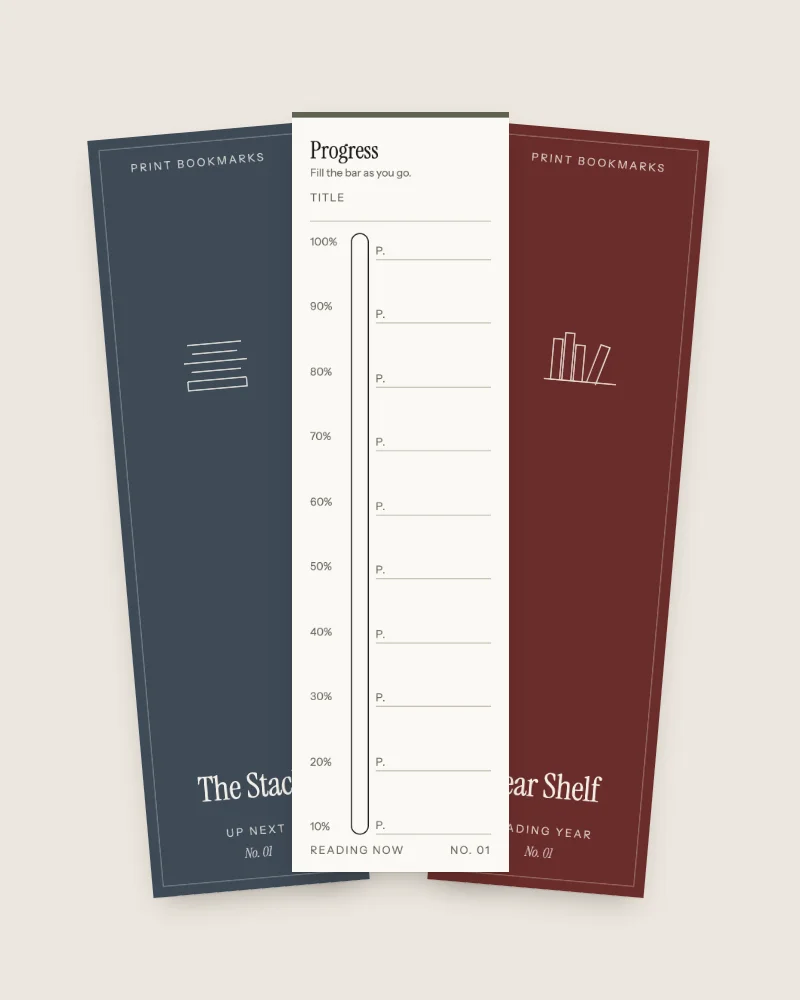
Keep the list in the book, where you see it every evening. Our free challenge bookmark has twelve prompts, one book each. It prints on one sheet with three other tracker bookmarks, each 2 by 7 inches with cut marks, on 65 lb cover cardstock. A strip of card ruled into twelve lines does the same job by hand, and pencil lets you swap a prompt in March.
A steady year is also the pace of a book club, one book a month and a meeting to talk it over. A buddy read with one friend works the same way on a smaller scale. Agree on a stopping page each week and write it on a slip in both books. Long novels get much easier with someone waiting for you at chapter ten.
A big year of 24 prompts or more
Twenty-four books is two a month, and at that pace a published prompt list can do the choosing. Book Riot's Read Harder Challenge for 2026 has 24 tasks, two per month, and one book may count for several tasks. Graphic novels and audiobooks count as well. Its prompts send you toward books you would never find on your own, such as a microhistory or a book by a librarian.
Prompts and structures for a big year
Our free reading challenge sheet has 24 prompts of its own, one book each with a line for the title. They run from a book from the year you were born to a book a librarian recommends. Beyond 24 books, a structure does more than a list of prompts, and four of them work on paper.
- The alphabet, one book per letter by the first word of the title or the author's surname. Twenty-six books is a big year, and Q, X and Z are hardest. Keep a list of all 26 letters and pencil in candidates as you spot them.
- Around the world, a book set in, or written by an author from, each of a set of places. Seven continents makes a manageable year and a country a month makes a richer one. The StoryGraph's challenge directory runs a Reads the World challenge with 10 prompts. A paper map with a dot per book works just as well at home.
- A decade challenge, one book published in each decade from the 1900s to the 1990s, ten books and a sense of how writing changed. A few of the older ones will move slowly, so pair them with lighter reads.
- A page count, with the year's target set in pages, so a 900-page novel counts for what it is. You need a running total and the page count of each book, written on the last page of your log as you finish.
Where to keep count
A sheet on the wall beats a bookmark at this level, because 24 lines do not fit on a 2 by 7 inch strip. Keep the sheet where you choose books, by the shelf or next to the library bag, and fill in the title the day you finish. If you would rather see the year as a picture, a bookshelf tracker gives you a spine to color for every finished book.
If what keeps you going is a crowd, use an app. Goodreads runs a yearly reading challenge, suggests starting with a number that feels easy, and counts Kindle books automatically once your Amazon account is linked. The StoryGraph's featured challenges each draw tens of thousands of participants. Paper will not connect you to anyone, so if comparing progress with strangers is what gets you through February, our sheet is the wrong choice.
Falling behind
Lower the number before you do anything else. On Goodreads you can change your goal anytime. On paper you cross out 24 and write 18, which is still one and a half books a month. Prompts you cannot fill swap for the wild card or move to next year.
Short books break a slump, and so do audiobooks, which Read Harder counts. Drop to a month on the minutes streak, because fifteen minutes is easier to start than a whole book. The count takes care of itself once the habit is back. Reading a little faster helps at the margin, though it will not close a gap of ten books.
Do you count the book you gave up on? Count it as abandoned, with the page you stopped on, and move to the next prompt. If it is October and the sheet has eight lines filled, finish the year at the steady level. Start January at the level you actually read at.
Sources
- Goodreads, Join the Goodreads Reading Challenge (2026) (last checked 2026-10-02)
- Book Riot, Book Riot's 2026 Read Harder Challenge (2025) (last checked 2026-10-02)
- The StoryGraph, Reading Challenges (2026) (last checked 2026-10-02)
- Pew Research Center, Three-in-ten Americans now read e-books (2022) (last checked 2026-10-02)