Book Club Questions: A Set for Every Part of the Meeting
Open with one question everyone can answer, finished or not: which moment in the book are you still thinking about? After that round, work through the meeting in parts, the characters, the ending and what you take home, with three or four book club questions from each set below. The last section covers how to start a club, from the number of people to where you meet and how often.

Start with one question everyone can answer
Go around the circle once before anyone gives a verdict. Put the same question to each person: which moment in the book are you still thinking about? Everyone has an answer, including the member who stopped at page 60. After one round a dozen scenes are on the table, and nobody has said yet whether the book was good.
Keep the opening round short, about a minute per person, so a group of 10 is done in 10 or 12 minutes. The American Library Association's facilitating guide says "like" and "dislike" do not move a discussion forward. That is why the opening question asks for a scene, and the ratings can wait. Pick one of these for the round and keep the rest for next month:
- Which moment in the book are you still thinking about?
- Where were you in the book when you knew whether it was for you?
- Which character would you have warned, and about what?
- What did the cover and the first page promise, and what did you get?
- If you stopped early, where did you stop, and what stopped you?
- Which line did you read twice?
A club that dislikes going around the circle can start on paper instead. Hand out a crossword built from the book as people arrive, with character names and places as the answers. The first 10 minutes then look after themselves, and the people who finish the puzzle first have already started talking about chapter 3.
Book club questions about the characters
Give the people in the book the longest stretch of the meeting, say 30 of your 90 minutes, because that is where opinions split. The ALA guide suggests asking whether the characters seem convincing. It also asks members to back a view with a passage, which it calls close reading. Read the lines aloud, then say what they show. One passage per claim keeps the talk on the book and away from "I just didn't buy her."
- Which character changed most between the first chapter and the last, and what changed them?
- Who did you trust at the start and stop trusting? Where exactly did that happen?
- Which decision would you have made differently, knowing only what the character knew at the time?
- Is there a character the author seems to like more than you do?
- Which minor character could carry a book of their own?
- Whose side of the story never gets told?
- Find one passage where a character surprised you and read it aloud. Was the surprise set up?
The passages work better when they are short. Ask members to mark one page before the meeting with a flag or a folded corner, and to read 5 to 10 lines, no more. Then the reader says in one sentence what the lines show. A member who reads a page and a half loses the room before the point arrives.
Then a few words on the writing itself. ReadingGroupGuides.com keeps a general set of fiction questions on characters, structure, language, plot, themes and setting. It notes that a group need not use all of them and can follow its own interests. Two questions on the writing are usually enough for one meeting.
- Where did the structure help you, and where did you have to flip back?
- Which sentence would you show someone to explain how this author sounds?
For a nonfiction book, swap the character questions for the author's case. The ALA guide suggests asking what evidence the author uses and whether it convinces. Ask which chapter made the argument, which chapter you would have cut, and what you would need to see before you changed your mind.
Questions about the ending
Hold the ending until everyone who finished has had a say on the characters. Then ask the question the ALA guide suggests for fiction: did the ending feel earned? An ending that felt earned to 4 people and cheap to 6 makes a better 20 minutes than one the whole room agreed on.
- Did the ending feel earned, or did the author step in?
- At what page did you know how it would end, if you knew?
- What would have to change earlier in the book for this ending to work for you?
- Who got what they deserved, and who did not?
- Would you have ended it one chapter sooner or one chapter later?
- If there is an epilogue, did it add something or explain too much?
Members who did not finish still belong in this part. The ALA guide welcomes them, and the ending round is where they contribute most. Ask them how they thought it would end, then let the finishers tell them what happened. Say out loud that the ending is about to be discussed before you open this section. Nobody who is still reading should hear the last page by accident.
The take-home: what stays after the meeting
Close the discussion with the questions that connect the book to the people in the room. Those are the answers people repeat on the drive home. Keep this round to 15 minutes and 2 questions at most. Ask them in the order below, because the first ones are easy and the later ones get personal.
- What will you remember about this book in a year?
- Did the book change your mind about anything, even slightly?
- Who would you give it to, and what would you tell them first?
- What did this book do that the last three the group chose did not?
- Which question did the book raise and never answer?
The ALA guide prefers asking how the book made members feel over a plain like or dislike, and this round is where that question fits. Members who think best on paper will have more to say if they write a few lines before the meeting. The journal prompts sorted by two, ten or thirty minutes work for a club book as well as a private one.
Keeping the talk going for 60 to 90 minutes
Plan on 60 to 90 minutes of book talk inside a meeting of 2 to 2.5 hours. That is the shape the ALA guide describes once arrivals and food are counted. The question sets above are the backbone, and a few habits keep the time from leaking away.
Disagreement is the point. The ALA guide calls differing opinions good. When two members split over the ending, slow down there and ask each of them for a passage. The argument about one scene is usually the part of the evening people remember.
Nobody owns the floor. If one person answers every question, the ALA guide suggests inviting others by name. Or pass an object around the circle, so that only the holder speaks. A paperback works as well as anything.
Penguin Random House's club tips suggest that every member brings a question or topic to each meeting. That spreads the preparation over 10 people instead of 1. The ALA guide adds a shortcut for the host. Check the back of the book or the publisher's website for a reading guide before you write your own.
Choosing the next book
Pick the next book at the end of the meeting, while everyone is in the room. Pick it for the discussion it will give you. Penguin Random House suggests books with something to argue about, such as complex plots or characters, controversial subject matter or social commentary. It also says to choose a book long enough to encourage a good discussion and short enough for people to finish on time. Every member suggests a title, and then the group votes.
A vote between 3 titles settles faster than a vote between 10, so collect suggestions a month ahead and shortlist them. If the club keeps stalling at this step, the six ways of choosing the next book give one reader a method to settle it alone. They come back with a shortlist, and the vote takes 5 minutes.
Some clubs add a year-long game. Our free book bingo and reading challenge sheets carry 24 prompts each. The bingo is a 5 by 5 card with a free center, and the challenge sheet has a line for each title. Members tick them off with whatever they read between meetings, so they suit a club whose members read different books and report back. For a club that reads one shared title a month, the sheets are the wrong tool, and the shortlist and the vote do the job.
Starting a book club
Start with 8 to 16 people, meet monthly, and hold the first meeting somewhere you can come back to. The ALA's guide to starting a discussion group gives 8 to 16 members as the best size. It says monthly works best for most clubs, with some meeting every six weeks. Below 8, two absences leave you with a conversation. Above 16, the opening round alone runs past 20 minutes.
Pick a place people can get back to every month. A living room with enough chairs works when the hosting rotates and the host of the month picks the snacks. A library meeting room or the quiet end of a cafe suits a club whose members do not know each other yet. Nobody has to open their home to strangers at the first meeting.
How often depends on the books. Monthly gives everyone about 4 weeks for a 300-page novel, which is enough at 20 pages a night. Every six weeks suits a club that likes long nonfiction. Choose the first 3 books in one sitting, so nobody has to pick under pressure, and set an end time as well as a start time.
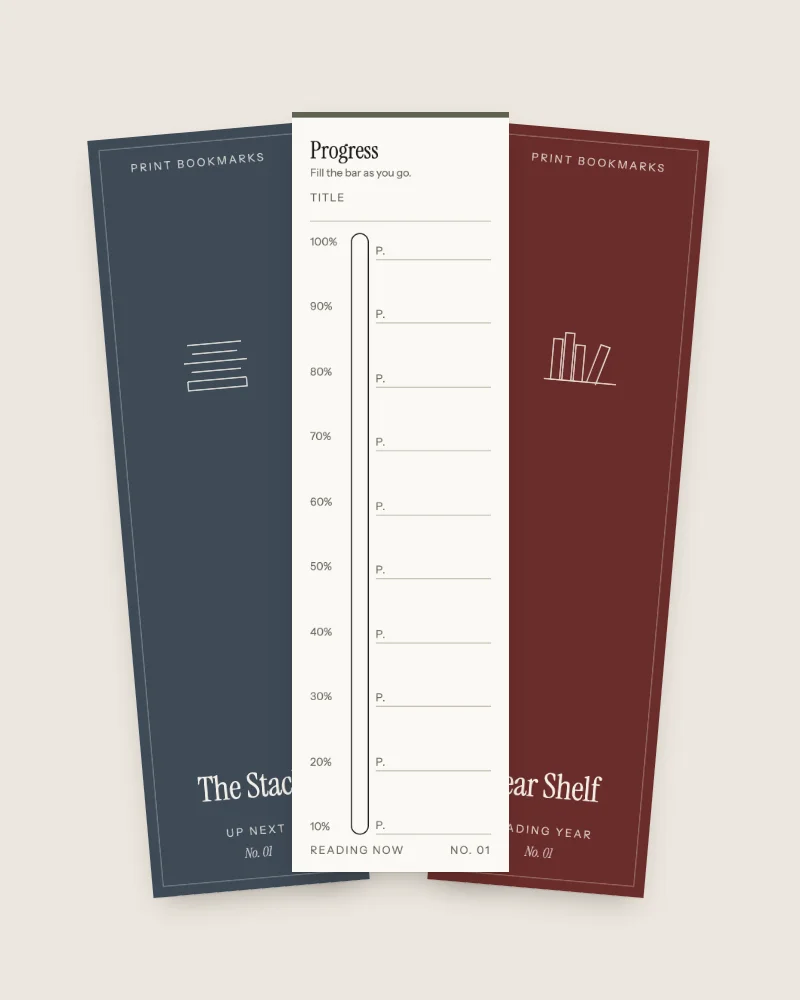
Settle a few rules at the first meeting too, while nobody has broken them yet. Decide whether people who did not finish still come (yes), whether the ending waits for a warning, and who hosts next. Then write the first three dates somewhere people will see them again. Our free Up Next tracker set has a bookmark for book club meetings, 2 by 7 inches, that stays inside the current book. Fill in the next three dates and titles before anyone leaves.
Sources
- American Library Association (ALA LibGuides), Starting a Book Discussion Group (n.d.) (last checked 2026-10-13)
- American Library Association (ALA LibGuides), Hosting and Facilitating (Book Discussion Groups) (n.d.) (last checked 2026-10-13)
- ReadingGroupGuides.com (The Book Report Network), Fiction Discussion Questions (n.d.) (last checked 2026-10-13)
- Penguin Random House, Tips on Creating a Book Club (n.d.) (last checked 2026-10-13)