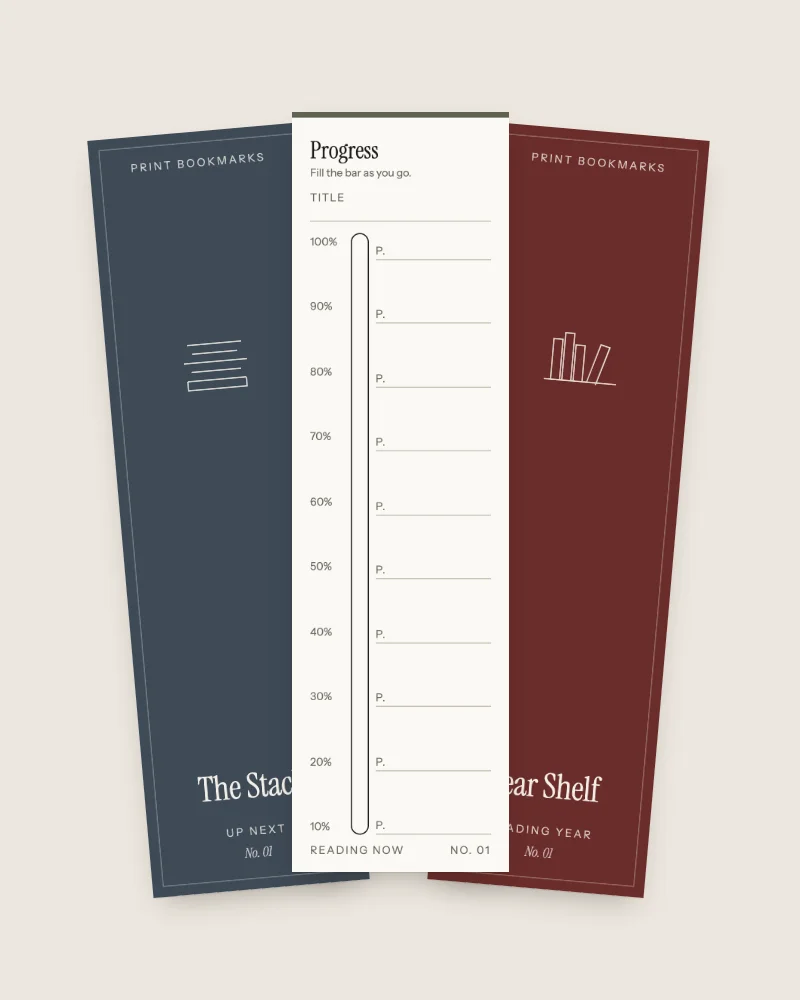
Reading Journal Prompts: 42 Ideas to Copy
You finish a book, open your journal and find the blank page staring back. Reading journal prompts fix that by handing you a question to answer. The 42 below are sorted by when you reach for the notebook, from before the first page to a re-read years later, with a group for books you quit.
What Is a Reading Response Journal?
A reading response journal is a notebook where you write your own reaction to a book, beside the part of the book that caused it. Teachers use the idea with students, and adults can borrow it for any book they like.
The most common layout is a two-column chart. The Association for Middle Level Education describes a double-entry journal as a T-chart. On the left, readers copy something notable from the text, such as a sentence, a quote, a new word or a character. On the right, they write their response, which can be a question, a prediction, a connection or an opinion. The article suggests headings as simple as "Text" and "Thoughts."
1. Before You Start: Prompts for the First Page
Prompts before reading capture what you bring to a book, which is the part you cannot recover once the story has changed you. Answer them while the book is still closed. Two lines each is plenty.
- What made me pick this up, and what do I hope it gives me?
- What do the title and cover promise, and what mood do they set?
- What do I already know about the author or the subject?
- What is going on in my life right now that may color how I read?
- Which one question do I want this book to answer?
2. While You Read: Prompts for the Middle
Prompts in the middle of a book work best as quick notes beside a page number. They catch reactions that fade by the time you finish. Keep a pencil in the book.
- Which line made me stop, and what page is it on?
- What do I think will happen next, and why?
- Where did my attention drift, and what pulled it back?
- Which part confused me, and what would I ask the author?
- Has my opinion changed since the first chapter?
3. After the Last Page: Prompts for Finishing
Prompts for the end of a book ask you to judge it while the ending is fresh. Write your answers the same day if you can. Your verdict will be sharper before you pick up the next book.
- What is this book about in one sentence, in my own words?
- Which scene or idea will stay with me longest?
- What would I change about the ending?
- Who would I hand this book to, and what would I say?
- What rating do I give it, and what is the one reason?
Our guide to what to write in a reading log covers the quick facts, such as dates and ratings, that go alongside these answers.
4. Characters and Setting: Prompts for People and Places
Character and setting prompts turn your attention from the plot to the people and the place. They suit novels, memoirs and biographies alike. Pick one and write a short paragraph.
- Whom do I trust least, and what did they do to earn that?
- Which character do I understand best, and what do I recognize in them?
- Which choice would I have made differently, and why?
- Who changes the most, and what causes the change?
- Which minor character deserves more pages?
- Where does the story happen, and would it work anywhere else?
- Which place would I visit, and which would I avoid?
5. The Writing: Prompts for Style and Craft
Craft prompts help you notice how a book is built, which makes you a sharper reader of the next one. They also work for books you did not enjoy, because a clumsy structure is still worth naming.
- Which sentence would I copy by hand, and what makes it work?
- How does the author handle time, in a straight line, in jumps or in flashbacks?
- What does the narrator know that I do not?
- Which word or image keeps coming back?
- Where does the pace speed up, and where does it slow down?
6. Non-Fiction: Prompts for Books That Teach
Non-fiction prompts ask what the author claims and whether you accept it. You are checking an argument here, so notes about evidence matter more than notes about mood.
- What is the author's main claim, and what evidence supports it?
- Which idea is new to me, and which one did I already believe?
- What will I do differently this week because of this book?
- Which claim do I doubt, and what would convince me?
- Which question does the book leave me with?
A layout from Cornell University suits these books well. The alumni magazine Cornellians describes the system devised by education professor Walter Pauk. Notes go in a wide right-hand column, and you write questions in a narrow left-hand cue column afterward. A summary goes across the bottom of the page. Pauk's own advice was to keep the cue column empty while taking notes and to draw questions from the ideas when you review.
Pro Tip: Borrow Cornell's cue column for a non-fiction book. Write notes on the right while you read. Once you finish, turn the prompts above into questions on the left and add a one-sentence summary underneath.
7. Re-Reads: Prompts for Books You Know
Re-reading prompts measure the distance between the reader you were and the reader you are. Write them in the same journal as the first entry, or copy your old verdict beside the new one.
- What do I notice now that I missed the first time?
- How have I changed since the first read?
- Does the book hold up, or has my taste moved on?
- Which line hits differently now?
- Would I recommend it to the person I was when I first read it?
8. Books You Disliked or Did Not Finish: Prompts for Quitting
A book you disliked or stopped reading still deserves a short entry. The entry records why it failed, which makes your next choice better. Mark the page where you stopped and write one answer.
- At what page did I stop, and what was happening there?
- What did I expect, and what did I get instead?
- Was the problem the book, or the moment I picked it up?
- Would I try it again later, and what would need to change?
- What did I learn about my taste from not finishing it?
How to Use a Reading Journal Prompt
Answer one to three prompts per book, each in two or three sentences. Answering every prompt for every book turns the journal into homework. A single honest answer beats ten padded ones.
You can keep a fixed set or rotate. A fixed pair, such as the line that made you stop and your verdict, makes entries easy to compare across books. Rotating through the list keeps entries fresh. A good mix is two fixed prompts for every book and one rotating prompt when a book calls for it.
Start the answer with the page number, then the line, then your reaction. An invented entry shows the shape. For "Which line made me stop?" you might write "p. 112, She kept every letter and answered none. I think she is protecting someone, and I want to know who." That is the whole entry.
Key Takeaway: A prompt works best when it points at a specific line. A page number on the left and a reaction on the right, as in the two-column chart, give you something to compare when you reread.
If you have not set up a notebook yet, our guide on how to start a reading journal covers the pages and the habit. Once you have somewhere to write, pick a group and begin.
How to Avoid Spoilers in Entries for a Book Club
Write your private entries without worrying about spoilers, and keep a separate line for sharing. A journal is for you, so name the ending when you need to. For a book club, add a short line without spoilers at the end of the entry, such as your rating and one reason, and circle it so you can find it fast.
Choose prompts that start a conversation without giving the plot away. "Which character do I trust least?" and "Which line made me stop?" work well, and "What would I change about the ending?" waits until everyone has finished. Our Up Next bookmark set has a Book Club bookmark with space for the date, the book, the place, what to bring and four meetings.
How to Choose Reading Journal Prompts
Choose by what you want to remember. If you want your first impressions, use the before and while groups. If you want a verdict, use the after group. Characters and craft suit fiction, and the non-fiction group suits books that argue.
| You want to | Use | Where to write it |
|---|---|---|
| Capture your reason for starting | Group 1, before you start | The top of the book's page |
| Catch reactions as they happen | Group 2, while you read | A bookmark or margin slip |
| Judge a book you just finished | Group 3, after the last page | A full notebook page |
| Understand why a story works | Groups 4 and 5, characters, setting and writing | A notebook spread |
| Test an argument | Group 6, non-fiction | A cue column and summary |
| Compare two readings of a book | Group 7, re-reads | Beside your first entry |
| Understand a book that did not work | Group 8, disliked or unfinished | A short entry on the book's page |
Where Our Bookmarks Fit
A paper bookmark suits the short prompts. The Lines to Keep bookmark in our Reading Now set has ruled space for the page number and the line. It answers the prompt about the line that made you stop. The Last Page bookmark holds dates, a rating and one line for the after-reading prompts. Each bookmark trims to 2 by 7 inches, and the set has six.
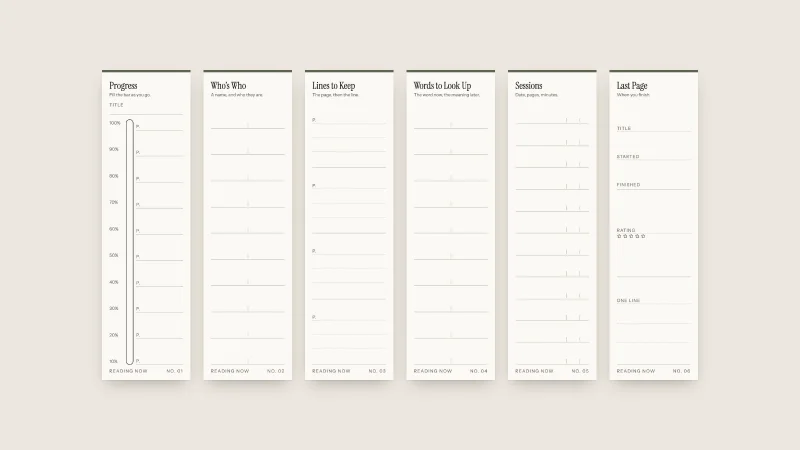
Bookmarks have little room, so a long answer belongs in a notebook. If you like to write a full paragraph about every book, a notebook is the better tool and our bookmarks only help with the short notes.
FAQ
What are some good prompts for writing a reading journal?
Good prompts ask for a reaction to something specific. Try "Which line made me stop?" while you read, "What would I change about the ending?" when you finish, and "What do I notice now that I missed the first time?" for a re-read.
What is a reading response journal?
A reading response journal is a notebook where you write your own reaction to what you read. Many use two columns, with a quote or page number on the left and a response on the right.
How many prompts should I answer for each book?
One to three. Two fixed prompts for every book, plus one rotating prompt when a book calls for it, keep entries short and comparable.
What do I get with Reading Now, and can I print it again?
You get a zip with a US Letter PDF, an A4 PDF and a README, and a receipt email brings the download link right after payment. Any home inkjet or laser printer works. Print the test sheet on pages 3 and 4 first, then print at actual size (100%) on matte card of about 176 gsm (65 lb cover), flip on the long edge and cut. You may print as often as you like for you and your household, and give printed bookmarks or sheets as gifts. Please do not share or resell the file.
Conclusion
A good prompt is a small question that points at a real line in a real book. Pick one to three per book and write two or three sentences beside a page number. Choose the group that matches your moment, whether that is before the first page, in the middle, at the end or on a re-read. The answers add up to a record of how you read.
Sources
- Association for Middle Level Education, During Reading Response: Double-Entry Journals (n.d.) (last checked 2026-10-05)
- Cornellians, Take Note: Popular Study Method has "Cornell" Written All Over It (2022) (last checked 2026-10-05)