What to Write in a Reading Log: How to Fill Each Entry

You close the last page, pick up your pen and the line stays empty. What to write in a reading log comes down to two layers, a few facts you can fill in without thinking and one line on why the book landed the way it did.
Step 1: Write the Facts First
Facts are quick. They take no thought and make every later note easy to find. Write the title, the author, the date you finished and the format. Add the page count only if you track pages.
An entry can grow in four sizes, and you can pick a size per book. A busy month may only earn the facts. A book that stayed with you can earn the fuller entry.
| Entry size | What to write | Example (invented) |
|---|---|---|
| Facts | Title, author, date finished, format | A Quiet Harbor, Mara Ellis, Mar 19, audio |
| Facts and stars | The facts plus your rating | The same line, 4 stars |
| Facts and a line | Add one sentence on why | "Slow start, but I stayed up for the last hundred pages." |
| Fuller entry | Add a line to keep with its page number and one open question | p. 212, "The tide does not ask." Why did she stay? |
Step 2: Add One Line on Why
Be specific. The most useful thing to write is one sentence on why the book worked or did not. A rating tells you how much you liked a book, and the line tells you what you liked. Write it from memory before you reopen the book or read anyone else's review.
Recalling a book without peeking also helps it stick. The Eberly Center at Carnegie Mellon University describes retrieval practice as asking learners to recall information from memory. It adds that attempting to retrieve something and getting it wrong is still more beneficial than simply reading over the correct information. A one-line verdict written from memory is a small version of that.
Pro Tip: Start the line with a verb about you, such as "I stayed up", "I skimmed" or "I reread". A verb forces a specific answer, and the word "good" cannot follow it.
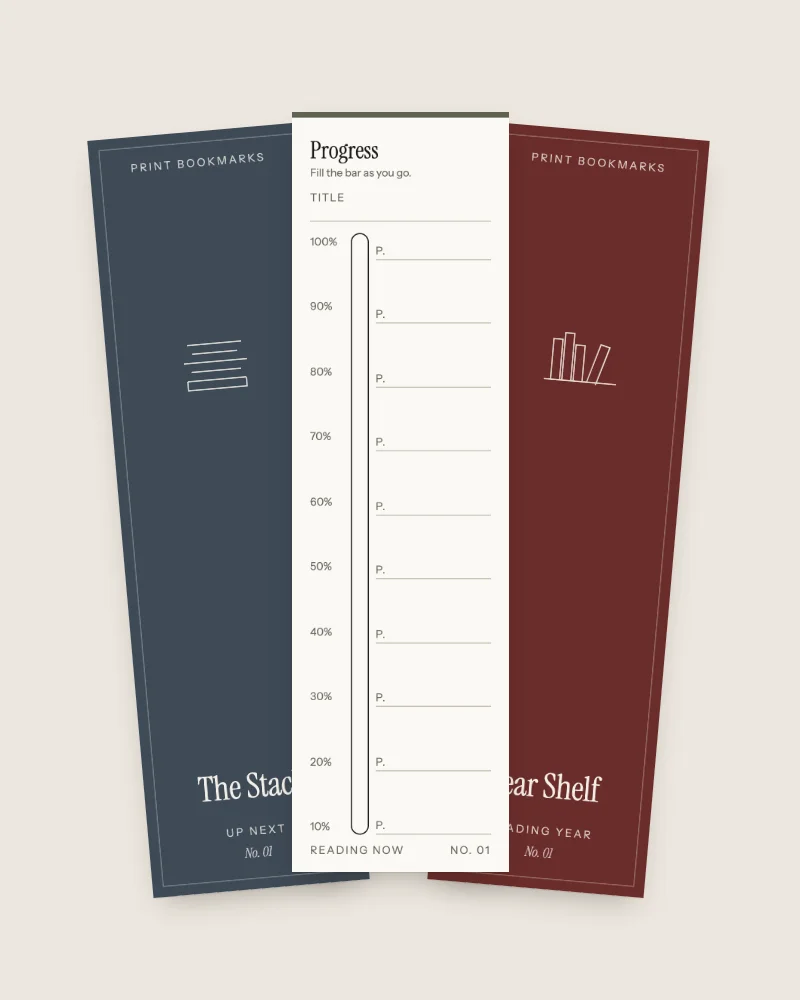
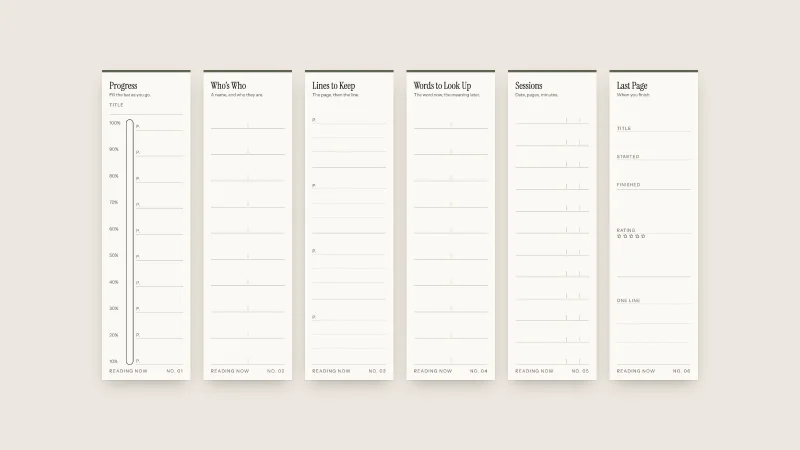
Our Reading Now set has a bookmark for exactly this. Its back, called Last Page, has ruled space for the dates, a rating and one line, so the verdict goes down where the book ends.
Step 3: Shape the Entry for Fiction or Non-Fiction
Fiction and non-fiction ask for different second lines. For a novel, write how it made you feel. For a book of ideas, write what you would do or tell someone as a result.
| Field | Fiction entry (invented) | Non-fiction entry (invented) |
|---|---|---|
| Title and author | A Quiet Harbor, Mara Ellis | The Long Thaw, Dev Raman |
| Finished and format | Mar 19, audio | Feb 2, print |
| Rating | 4 stars | 3 stars |
| One line on why | Slow start, but I stayed up for the last hundred pages. | Two chapters repeat the first, yet the weekly review idea is worth trying. |
| Line to keep | p. 212, "The tide does not ask." | p. 88, the three-question review |
Non-fiction rewards your own words. A learning guide from Indiana University says that writing information down gives you another way to hold it in working memory and encode it for long-term memory. So summarize the idea in a sentence of yours, then add the page where the author states it.
A book you stop reading still gets an entry. Write the page where you stopped and one line on why, and mark it with a small cross instead of stars. A line such as "Stopped at p. 90, too many characters to keep straight" saves you from picking the same book up again.
What to Write in a Reading Log When Nothing Comes to Mind
Starters help. When no line arrives, borrow one and finish it honestly. Short comments work best when they name what you felt.
- "I could not put it down."
- "I laughed out loud on page 40."
- "Beautifully written, slow to start."
- "Changed my mind about something."
- "I will reread this one."
- "Not for me, but I see why others love it."
Step 4: Pick a Ratings Key
A ratings key is a short note that says what each star count means to you. Write it once on the first page of your log and keep to it. Without a key, a four in January and a four in November can mean different things.
| Stars | What it means in this key |
|---|---|
| 5 | I will reread it or press it on a friend |
| 4 | Glad I read it |
| 3 | Fine, and it held my attention |
| 2 | Finished it out of stubbornness |
| 1 | Finished it and wish I had not |
Some apps allow finer steps. A roundup from Seymour Library notes that The StoryGraph offers half and quarter stars. On paper, whole stars are enough, and fewer steps make you decide.
Step 5: Turn the Log Into a Yearly Graph
A log becomes a graph when you count something once a month. The easiest count is the number of books finished in each month. Color one square per book on graph paper, and the shape of your year appears.
Two more counts are worth a page. Tally your ratings to see whether you give mostly fours, and tally formats to see how much you listen. Our guide to tracking the books you read this year compares formats for the full-year view.
Key Takeaway: One count a month is enough for a graph. Finish a book, add a square, and the chart draws itself by December.
When a Bookmark Log Is Too Small
A bookmark back holds the dates, a rating and one line, so it is the wrong choice when you want paragraphs on every book. Notebooks have room. Our list of reading journal prompts offers questions to answer there.
Overview of the Five Steps
| Step | What you write | What it gives you |
|---|---|---|
| 1 | Title, author, date finished and format | A record you can find again |
| 2 | One line on why, from memory | The reason behind your rating |
| 3 | A feeling for fiction, an idea for non-fiction | Notes that fit the book |
| 4 | Stars, using a key you wrote once | Ratings that stay comparable |
| 5 | A monthly count of finished books | A graph of your reading year |
FAQ
How to write a reading log example?
Write the title, author, date finished and format, then a rating and one sentence on why. For example, "A Quiet Harbor, Mara Ellis. Mar 19. Audio. 4 stars. Slow start, but I stayed up for the last hundred pages."
What comments to write in a reading record?
Write what you felt and why, in your own words. "Kept me up past midnight" and "Taught me one thing I will try" are specific enough to jog your memory later. School reading records often use comment banks written for pupils, and those are a different thing from a log you keep for yourself.
What are some short positive comments I can write about my reading?
Try "I could not put it down", "Beautifully written", "Made me laugh out loud", "Changed my mind about something" or "I will reread this one". Add the page or scene that earned the comment so it means something in a year.
What do I get with Reading Now, and can I print it again?
You get a zip with a US Letter PDF, an A4 PDF and a README, and a receipt email brings the download link right after payment. Each set has six bookmarks, front and back, three to a sheet, and each bookmark trims to 2 by 7 inches (5.1 by 17.8 cm). Print at actual size (100%) on matte cardstock of about 176 gsm (65 lb cover). You may print as often as you like for you and your household, and give printed bookmarks or sheets as gifts. Please do not share or resell the file.
Conclusion
A good reading log entry can be very short. Write the facts, add one line on why from memory, use a ratings key you wrote once and count your finished books each month. Together those habits turn a list of titles into a record you can learn from. Pick the book you finished last and write its line now.
Sources
- Carnegie Mellon University Eberly Center, Retrieval Practice for Improved Learning (n.d.) (last checked 2026-10-05)
- Indiana University Learning, Reading, writing, taking notes (n.d.) (last checked 2026-10-05)
- Seymour Library, How to Track Your Reading Goals (2026) (last checked 2026-10-05)