How to Make a Crossword Puzzle by Hand in 5 Steps
Plan on about 8 to 12 words for a first crossword puzzle made by hand. That is enough to fill a grid of 10 squares a side and few enough to link without a fight. The five steps are the word list, the grid, the numbers, the clues and the answer key, and the materials are graph paper, a pencil and a pen.
Pick the words before you draw anything
Start with 8 to 12 words on one theme and write the letter count next to each. For a class, take the week's vocabulary or the names and places from the book you are reading. Drop any word under 3 letters. Keep a mix of lengths, since a grid of 4-letter words links poorly and one of 9-letter words runs off the paper. That list is also the whole answer to how to make a crossword puzzle for free. Graph paper and a pencil cost nothing.
Then look for shared letters, because every word has to cross at least one other. Underline the vowels and the common consonants R, S, T, N and L, which make the easiest crossings. A word like RHYTHM (one vowel, no S) goes to the bottom of the list as a reserve.
Who makes the list depends on the age. A 9-year-old can choose the words and count the letters alone. Fitting them together usually needs an adult or a child of 11 or 12. For children under 7, a word search is the better puzzle, because it needs no clues and no crossings. For a book club, 10 character names and places from the novel make a five-minute warm-up before the book club questions start.
How to make a crossword puzzle grid on graph paper
Use graph paper with half-inch squares, or rule your own, and write the longest word across the middle in pencil. Hang the second word off it, running down through a shared letter. Keep adding words one at a time, each crossing a word already on the paper. Pencil matters here, because the fourth word rarely fits where you first put it.
The first crossword was drawn by hand too. The Library of Congress attributes the earliest one to Arthur Wynne. His hand-drawn, diamond-shaped "FUN's Word-Cross Puzzle" ran in the New York World on December 21, 1913, and the format spread quickly to other US newspapers. So the grid does not have to be a square.
Two shapes are open to you. A newspaper crossword fills a square with black squares. CommuniCrossings, a constructor's site, quotes the New York Times guideline for it. Such grids need black-square symmetry, usually 180-degree rotational, answers of at least 3 letters, no unchecked squares and "all-over interlock" with no cut-off islands.
The other shape is the classroom crossword, an open grid where the words float on white and only the crossings are shared. Make that one by hand. Crossword Unclued points out that symmetry does not affect the solving anyway. It helps the setter keep the grid consistent, which a 10-word puzzle does not need.
Three rules still apply to the open grid. Every crossing letter must spell both words correctly. No two words may run side by side one row apart, since the touching letters form pairs that look like words and are not. And leave one empty square between the end of one word and the start of the next in the same line.
If the fitting is the part you dread, the free Crossword puzzle maker takes up to 20 words with a clue each and keeps the most compact open grid it finds. It builds this open shape only. For a symmetric newspaper grid, or when a child should do the fitting as the exercise, stay with the graph paper.
Number the squares
Number only the squares where a word begins. Scan the grid row by row from the top, left to right. Each time you reach a square that starts an across word or a down word, give it the next number. What about a square that starts both an across and a down word? It gets one number, used for both. Squares in the middle of a word get nothing. A 10-word puzzle usually ends up with 8 to 10 numbers, since some words share a starting square.
Write each number small in the top left corner of its square. Draw the square outlines and the numbers in pen, and keep the letters in pencil. Photocopy that sheet once with the letters in, which gives you the answer key. Erase the letters and copy the empty grid for the class. A 7-year-old can help with the erasing. The numbering is a job for whoever drew the grid, because one skipped square throws every clue after it off by one.
Write clues that match the answers
A clue has to match its answer in part of speech, tense and number. A plural clue gets a plural answer, and "ran" gets a clue in the past tense. The clue never contains the answer or a form of it, so "The library's librarian" is out for LIBRARY. List the clues under Across and Down by number, and keep each under about 10 words so the list fits beside the grid.
Difficulty comes from the clue, since the grid is the same for everyone. For a 7-year-old, write plain definitions, such as "Place where you borrow books". For a 5th grader reading a novel, copy a sentence from the book with the word blanked out. At any level, check that each clue fits only one word of that length. "Big cat" with 4 squares could be LION or PUMA, so add a detail that rules one out.
Keep an answer key
The answer key is the filled grid plus a list of the answers next to each clue number. The photocopy from the numbering step is the grid half. For the list half, write the number, the direction and the word on a separate sheet, Across first, then Down. Check the list against the grid letter by letter. For 10 words that is about 50 letters and takes 2 minutes.
The mistake this catches is a word that changed during the fitting while its clue still describes the old word. If STORY became YEAR at the last minute, "A tale with a beginning, a middle and an end" is now wrong for 5 Down. Keep the key with the blank copies and out of the solver's sight, so a second class next year gets both.
A book-themed crossword, built word by word
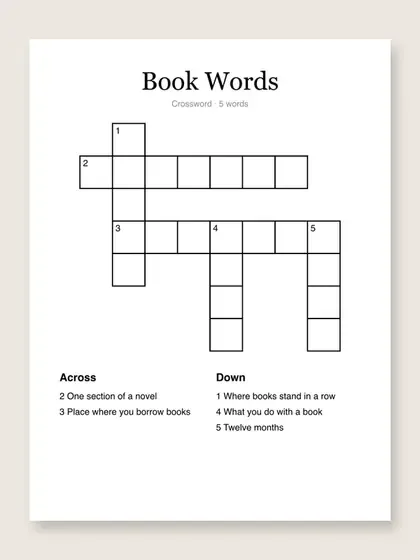
Start with five book words and their letter counts: CHAPTER 7, LIBRARY 7, SHELF 5, STORY 5, READ 4. Number the columns 1 to 8 from the left and the rows 1 to 7 from the top, so every square has a column and a row.
CHAPTER is one of the two longest words, so it goes across in row 2, from column 1 to column 7. SHELF shares an H with CHAPTER, so it runs down column 2. Its S sits in row 1, its H in the H of CHAPTER, and E, L and F fill rows 3, 4 and 5.
LIBRARY shares the L of SHELF, now in row 4. So LIBRARY runs across row 4 from column 2 to column 8, starting in that L. READ comes next. Its R matches the R of LIBRARY in column 5, so READ runs down column 5 from row 4 to row 7.
Then STORY shows where the fitting goes wrong. Its only free crossing is the S at the top of SHELF, which would put STORY across row 1 from column 2 to column 6. That lays STORY directly above CHAPTER, one row apart, and the touching letters make the nonsense pairs TA, OP, RT and YE. Swap it for YEAR. Its Y hangs off the last letter of LIBRARY in column 8 and runs down to row 7, with two empty columns between it and READ.
Now the numbers. Row 1 holds one starting square, the S of SHELF, so that is 1 Down. Row 2 starts CHAPTER at column 1, which is 2 Across. Row 4 starts LIBRARY at column 2, READ at column 5 and YEAR at column 8, so they become 3 Across, 4 Down and 5 Down. The clues follow in that order.
- 2 Across. One section of a novel
- 3 Across. Place where you borrow books
- 1 Down. Where books stand in a row
- 4 Down. What you do with a book
- 5 Down. Twelve months
The finished grid is 8 squares wide and 7 tall, which on half-inch graph paper is 4 by 3.5 inches. Four of the five words sit in the maker's Book words preset. Because the grid is under 9 squares across, the maker can also print it as four crossword bookmarks on one sheet.
Test it on one solver
Before you copy the puzzle for 25 students, give the blank grid and a pencil to one person who has not seen the word list. Watch without helping and note where the pencil stops. A stop of more than a minute on one clue usually means the clue is too vague or fits two words of that length. A letter written and erased at a crossing points to a crossing that spells one word correctly and the other not.
Fix those two things on the pencil copy, check the key once more against the changed clues, and only then make the class set.
Sources
- Library of Congress, Headlines & Heroes blog, Free Puzzles: Word Cross, Crosswords, and Acrostics (2021) (last checked 2026-10-13)
- CommuniCrossings (Steve Weyer), Constructing Crosswords: Grid (2026) (last checked 2026-10-13)
- Crossword Unclued (Shuchi), ABC of the Crossword Grid (2009) (last checked 2026-10-13)