How to Make a Word Search Kids Can Solve
Plan on a 10 by 10 grid and about 8 short words for a word search a child of 6 to 10 can solve. That is 100 squares, roughly 40 of them taken by the words and 60 left to fill with other letters. Everything below shows how to make a word search on that grid by hand, from the word list to the answer key, with pencil and squared paper.
Pick 8 words the child can already read
The word list decides whether the child can solve the puzzle, so build it before you draw a square. Take 8 words of 3 to 7 letters on one theme, all of them words the child has met in print. For a 6-year-old that is the week's sight words or the names from the book you are reading together. For a 9-year-old, the spelling list works.
Write each word in capitals and put the letter count next to it. No word may be longer than the grid is wide, so 10 letters is the limit here and 7 is a better one. Drop any word that sits inside another word on the list, BOOK next to BOOKMARK for example. The child finds BOOK twice and does not know which one to circle.
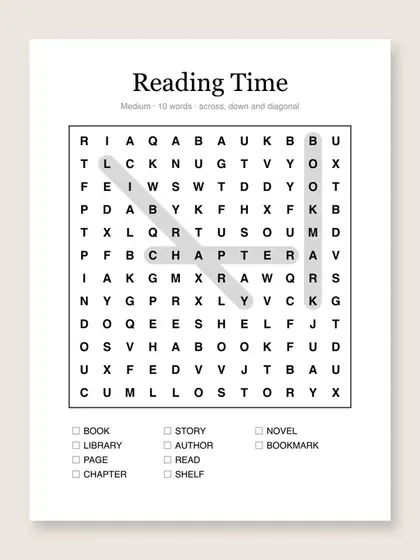
The example below uses reading words: LIBRARY, CHAPTER, AUTHOR, STORY, SHELF, BOOK, PAGE and READ, 42 letters in all. A 7-year-old can choose the words and count the letters alone. If the words are still new, read the list aloud together first. The same list also feeds the games for early readers, where a child hears and says each word before hunting for it.
Draw the 10 by 10 grid
Use squared paper with half-inch squares, or rule 11 lines each way on plain paper, half an inch apart, which gives you 100 squares. Half an inch suits a child's capitals. Quarter-inch graph paper is too tight for anyone under 10, because they circle the words with a crayon and take the neighbors with them.
Number the columns 1 to 10 across the top and the rows 1 to 10 down the side in light pencil. Those numbers let you note where each word went, which the answer key needs, and you erase them before you copy the puzzle. Everything inside the grid stays in pencil until the key has been checked.
A hand-drawn grid is also how the puzzle started. Grandmaster Puzzles records that the American word search was first published in 1968 in the Selenby Digest in Norman, Oklahoma. Its creator was Norman E. Gibat.
Place the longest words first
Put the two 7-letter words in first, because they have the fewest places to go. Then work down to the 4-letter words, which fit almost anywhere. For children under 8, run every word across from left to right or down from top to bottom. The full rule, as Grandmaster Puzzles states it, lets words run in one of eight directions, diagonals and backwards included. That version is for older solvers.
Here is the placing for the example, with rows counted from the top and columns from the left.
- LIBRARY across row 2, columns 2 to 8.
- AUTHOR down column 6 from row 2, starting on the A of LIBRARY.
- CHAPTER down column 2 from row 4.
- SHELF down column 4 from row 4.
- BOOK across row 5, columns 7 to 10.
- PAGE down column 10 from row 1.
- READ across row 7, columns 6 to 9, starting on the R that ends AUTHOR.
- STORY across row 9, columns 4 to 8.
Must the words share letters? No. Two of these do, so 8 words take 40 squares and leave 60 empty. A shared square is fine as long as both words still read correctly through it. Say each word out loud as you write it. The usual slip is a letter dropped from the middle of CHAPTER, which nobody notices until a child cannot find it. When a word will not fit, erase it and move it. Squeezing a letter into a corner square is how PAGE turns into PAG.
Fill the empty squares without giving the words away
Fill the 60 empty squares with letters drawn from the words themselves, so the hidden words do not stand out from the filler. In this puzzle that means plenty of R, A, E, O and T, and no Q, X or Z at all. A child learns within a minute to skip the odd letters. Spread the filler so that no letter appears 3 times in a row, and so that no second BOOK or READ turns up by accident.
Grandmaster Puzzles says a good word search has a unique solution reachable by observation alone. On a 10 by 10 grid that means every list word appears exactly once in the directions you allowed. Read each row and each column through once, looking for list words, and look backwards too. A reversed STORY confuses a solver even in an across-and-down puzzle. The finished example:
B H K O A Y L R B P
H L I B R A R Y D A
F R A A L U E A L G
R C P S T T R R G E
E H A H O H B O O K
T A S E R O I R O A
R P E L L R E A D C
E T H F P S E A P R
A E P S T O R Y O R
S R R H R B B R Y P
Write the 8 words under the grid as the list to find. If you would rather skip the filling and the checking, the free Word search maker does both for up to 20 words. It takes a grid from 10 by 10 to 20 by 20 and prints the answer key on page 2. It is the wrong tool when the child is meant to make the puzzle, because the placing and the checking are the practice.
Keep an answer key
Make the key before anyone solves the puzzle. Photocopy or photograph the finished grid once and shade each of the 8 words on that copy with a highlighter. Beside it, write the placing list in the form LIBRARY, row 2, column 2, across. Then read the shaded squares against the list letter by letter, 40 letters in all.
The key catches the mistake from the filling step, a list word that now appears twice, while a filler letter can still be changed. Keep the pencil original and the key together, out of the solver's sight, and copy the clean grid once per child. A 7-year-old can do the shading on the key. For a class, copy the puzzle on one side of the sheet and leave the back blank for a second try with the same list.
How to make the word search easier or harder by age
Change the grid size first, the word count second and the directions last, and keep the puzzle at a level the child can finish. The University of Michigan's Dyslexia Help page says word searches and crosswords can reinforce skills taught in intervention, at a level where a student can succeed. It files them as additional practice and would not recommend them as a brain break. A puzzle a 6-year-old cannot finish teaches nothing about the words.
- A 5-year-old gets a 6 by 6 grid, 4 or 5 words, all across from left to right, with the list read aloud first.
- A 6-year-old or 7-year-old gets an 8 by 8 grid, 6 or 7 words, across and down. The ready-made Christmas and Thanksgiving word-search bookmarks fit this age, with an 8 by 12 grid, 7 words across and down and a picture to color. They are the wrong pick when the words need to be the child's own.
- 8-year-olds to 10-year-olds get the 10 by 10 grid from this article with 8 to 10 words, then diagonals once that feels easy.
- From 10 up, add words backwards, on a 13 by 13 grid with 12 words or 16 by 16 with 18.
By 9 or 10, a crossword is the next step, since it adds clues, and Dr. Pierson on the same Michigan page calls crosswords a good way to build or reinforce vocabulary. A word search has no clues, so it practices looking and spelling. Once a child solves the 10 by 10 twice without help, hand over a blank grid and the pencil. Making the next puzzle for a younger brother or sister, 8 words placed and 60 filler squares checked, teaches the spelling a second time.
Sources
- Grandmaster Puzzles (Thomas Snyder), Word Search Rules and Info (n.d.) (last checked 2026-10-13)
- University of Michigan Dyslexia Help, Word Puzzles and Activities (Ask Dr. Pierson) (n.d.) (last checked 2026-10-13)