Sight Word Games for One Child, a Small Group or a Class
How do you practice sight words without a daily flash-card drill? Take the same 5 to 10 words the child is working on and put them into a game the child asks to play again, such as a word hunt around the room for one child, Go Fish for a small group or bingo for a whole class. These sight word games need paper, a pen and a few minutes, and all of them work with whatever list the school sends home.
When a game helps, and when it is too early
A game is for words the child has already met and reads correctly most of the time. Understood.org's description of the strategy starts with sound-letter mapping and moves on to a flash-card activity. Regular word games and activities come once the words are recognized consistently. So introduce 3 to 5 words, show how their sounds and letters match, practice them on cards for a few days, and then play.
What the games add is repetition. Understood.org describes orthographic mapping as the process of storing printed words in long-term memory and calls it essential for learning sight words. It also notes that the mapping can be hard for some children, who may need more exposures. A game that brings up the same 8 words twenty times in ten minutes gives those exposures without anyone counting. If you want the background on what makes a word a sight word, that article covers it.
Two cautions from the Iowa Reading Research Center keep the games in proportion. Sight word practice must be accompanied by phonics instruction. Children also need repeated exposures to the same words in books and other connected text, so a game is one part of the week, never the whole plan.
The games at a glance
Pick by the number of players you have and the minutes you can spare, since both change which game works. A memory match with 6 pairs is a quiet 10 minutes for one 5-year-old. The same cards split among 20 children is chaos, while bingo with one child is a drill in disguise. Every game below uses the same 8 to 12 words you are working on that week.
| Game | Group size | What you need | Minutes to plan on |
|---|---|---|---|
| Word hunt | 1 child | 8 to 10 word cards, tape | 10 |
| Swat the word | 1 or 2 | cards on the table, a fly swatter or a wooden spoon | 5 |
| Memory match | 1 to 3 | two cards of each word, 6 to 8 pairs | 10 |
| Hopscotch path | 1 to 4 | cards on the floor, or chalk outside | 10 |
| Go Fish | 2 to 5 | a deck with 2 copies of 10 to 12 words | 15 |
| Zap | 2 to 5 | 20 word cards plus 3 Zap cards in a cup | 10 |
| Roll and read | 2 to 5 | one die, a sheet with 6 rows of words | 10 |
| Stand up, sit down | whole class | a word wall or cards to hold up | 5 |
| Four corners | whole class | 4 word cards taped in the corners | 10 |
| Bingo | 4 to a whole class | one card per child, counters, a calling list | 15 to 20 |
Sight word games for one child at home
With one child, the best games put the words somewhere other than a table. A 4-year-old who has just sat through a flash-card session will not sit through a second one, so movement and a little silliness carry the repetition. Plan on 5 to 10 minutes, and stop while the child still wants more.
For a word hunt, write 8 to 10 words on cards and tape them around one room at child height, on the fridge, under a chair, on the bathroom mirror. Call a word and the child runs to find it, reads it out loud, and brings it back. Once all the cards are in, swap roles. The child calls while you hunt (badly, with wrong guesses the child gets to correct).
Swat the word takes 5 minutes and the same cards laid face up on the table. Say a word, and the child swats it with a fly swatter or a wooden spoon. Then the child says a word and you swat, slowly, so there is time to read along.
Memory match wants two copies of each word, 6 to 8 pairs face down in rows. Turn two over, read both aloud, keep them if they match. Reading each card aloud is the rule that makes it practice, so hold to it even when the child wants to play fast.
Hopscotch path works indoors with cards on the floor or outside with chalk. Lay 8 words in a winding line, and the child hops from word to word, reading each one before landing on the next. A misread word sends the child back to the start.
For the cards, index cards and a thick marker are fine, and a child of 5 or 6 can write some of them. If your list is the Dolch pre-primer set, the flash cards on our pre-primer page print all 40 words, 8 to a page with cut lines. An adult should do the cutting. If the school sent its own list, hand-write the cards instead, since 40 printed words you are not working on only add noise.
Games for a small group of 2 to 5
A small group changes what a game can do, because children now read each other's words as well as their own. Three to five players is the range where everyone gets a turn every minute or two. Above 5, half the group waits, and a waiting 6-year-old finds something else to do.
Go Fish is the strongest game at this size and takes about 15 minutes. Make a deck with 2 copies of 10 to 12 words, deal 5 cards each, and put the rest face down in the middle. On a turn a player asks another for a word by reading it from their own hand. If the other player has it, they hand it over and the pair goes down on the table. If not, the asker draws a card.
Each ask is a read, and each check of a hand is another. One round of Go Fish puts every word in front of every player several times, which is why it beats a flash-card round with the same 12 words.
Zap is faster and better for a group with mixed levels. Write 20 words on cards and 3 cards that say Zap, then put them all in a cup. Players draw one card at a time, read it, and keep it if they read it correctly. A Zap card sends all of that player's cards back into the cup. The luck evens out the gap between a strong reader and a weaker one, so a mixed group stays in the game longer than it would in a race.
Roll and read needs a die and a sheet with 6 rows of 5 or 6 words, numbered 1 to 6. A player rolls and reads the whole row for that number. Keep the sheet to the week's words plus a few from last week, so every row holds something easy and something harder.
Games for a whole class
A class game has to keep 20 or more children reading at once, so the good ones have everybody answer every call. One child at a time at the front leaves 24 others waiting. Keep each round under a minute and the whole game to 5 or 10 minutes, then move on before the back row drifts.
Stand up, sit down takes no setup beyond a word wall or a stack of cards. Hold up a word and say a word. If they match, everyone stands, and if they do not, everyone stays seated. Five rounds take 2 minutes, and you can see at a glance who is reading and who is copying a neighbor.
Four corners works the other way around. Tape 4 words in the 4 corners of the room, call one, and the class walks to it. Swap the 4 cards every third round so the position never gives the answer away.
Bingo suits a class best, and it is also the game that most easily turns into a drill. A card with 24 words the class has not learned is 24 small failures. Build it from the words the class already reads, with 4 or 5 of this week's words mixed in, and use dried beans or torn paper as counters.
The free Bingo card generator shuffles a list onto up to 30 cards, on a 3 by 3, 4 by 4 or 5 by 5 grid. It also prints a calling list to tick as you go.
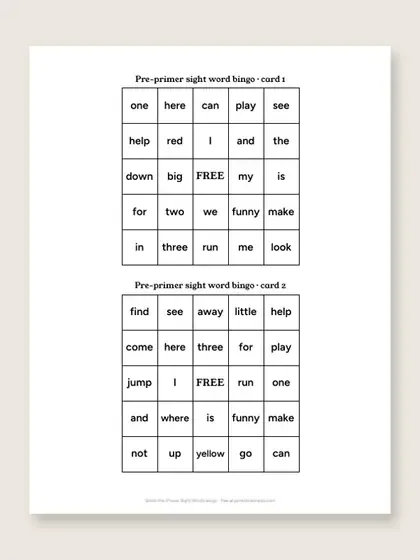
If you teach the Dolch pre-primer list, the same page where the flash cards live has 8 ready-made bingo cards, two to a page. For a class of 25 playing from a different list, those 8 cards are the wrong choice, because too many children would share a card. The generator or hand-drawn grids are the right tool there. For which 40 words to start with, see the kindergarten sight words list.
Mistakes that turn a game into a drill
The same five mistakes show up at home and in class, and each one ends a game early.
- Too many new words at once. Keep new words to 3 to 5 and fill the rest of the deck with words the child already reads, so most turns succeed.
- Speed before accuracy. A child who guesses at speed is practicing guessing. Reward the correct read, and only time the game once the words are solid.
- Letting the stronger reader win every round. Zap and bingo have enough luck in them to fix this. Memory match and Go Fish do not, so pair children of similar level for those.
- Playing the same game every day. Rotate 3 games across the week so the same words come back in a different form.
- Dropping the words once the game ends. The Iowa Reading Research Center says automaticity takes repeated practice, and the exposures that count most are in connected text. Read a picture book with the week's words in it after the game, and point them out when they appear.
Make your own game from any word list
Every game above is a word list plus one rule, so any list you have can become a game in 10 minutes. Write the words on index cards, one word per card, in the same lowercase the child sees in books.
For Go Fish or memory match you need 2 copies of each word. For Zap, 1 copy of 20 words plus 3 Zap cards. For a word hunt or hopscotch, 1 copy of 8 to 10 words. A child of 6 can copy the words onto the cards, and the copying is one more exposure.
Bingo cards need one word per square. A 3 by 3 card takes 9 words, or 8 with a free center, and a 5 by 5 card takes 25, or 24 with a free center. For one child or a pair, draw a 3 by 3 grid on paper and fill it by hand. For a class, the bingo card generator takes your own list typed one word per line and shuffles it onto a different card for each child.
The same list can also become a puzzle the child solves alone. The guide on how to make a word search shows a grid size a kindergartner can finish. Whatever game you make, keep the list on the fridge and tick a word off once the child has read it correctly on 3 different days.
Sources
- Understood.org, Sight words: An evidence-based literacy strategy (2019) (last checked 2026-10-13)
- Iowa Reading Research Center, University of Iowa, Teaching Sight Words as a Part of Comprehensive Reading Instruction (2018) (last checked 2026-10-13)