40 Sight Words for Kindergarten, and How to Teach Them
Forty words is a workable sight-word goal for a kindergarten year, and this plan uses the 40 Dolch pre-primer words, from a to you. Below they sit in four teaching groups, then in a 10-week plan with one activity per week, with a five-minute routine for home. No national standard sets a count, so check the number against your school's own list.
What kindergarten asks for, and where the 40 come from
Sight words are common words that schools expect children to recognize instantly, as Understood.org puts it. The Common Core kindergarten reading standard RF.K.3.c asks children to "read common high-frequency words by sight". Its ten examples are the, of, to, you, she, my, is, are, do and does. It names a skill and examples, and no count.
Knowing the standard matters for a parent setting a goal. Understood.org notes that schools set their own expectations by grade. Idaho's kindergarten essential standards guide repeats the same ten example words and adds the word automaticity, again with no number attached. So the 40 below is a planning figure taken from the Dolch list, and the school's own list wins where the two differ.
The Dolch list is older than any current standard. Edward William Dolch published 220 words in a journal in 1936 and in his 1948 book, with a separate list of 95 nouns, according to GreatSchools. The Iowa Reading Research Center adds that Fry's 1000 Instant Words list includes nearly all of the Dolch words, with 19 exceptions. A school that uses Fry teaches most of the same words. The pre-primer list is the first 40 of the 220. For the longer story of the lists, read what sight words are first.
The 40 sight words for kindergarten, in four groups
Here are the 40 Dolch pre-primer words sorted into four groups of ten by how a child meets them, instead of alphabetically. Teach a group together and the child gets a pattern to hang the words on. Glue words hold every sentence together, and colors and numbers already mean something to a 5-year-old.
- Glue words, in almost every sentence: a, and, the, to, I, is, it, in, you, we
- Action words a child can act out: go, come, run, jump, play, look, see, find, make, help
- Describing words, colors and numbers: big, little, funny, not, red, blue, yellow, one, two, three
- Place and story words: up, down, away, here, where, for, my, me, can, said
Some words in each group can be sounded out with the short-vowel phonics a kindergartner learns in the same months. And, big, can, in, it, not, run, up, red, jump and help all follow the rules. Others break them. The, to, you, said, where, one, two, come and little each have a letter or two that does not say what it should. That part is what the child memorizes. In said, the s and the d are regular, so point at the ai and let the child sound out the rest.
A week-by-week plan
Four words a week finishes the list in 10 weeks, which fits a fall or spring term with room for sick days and review. Each week pairs its four words with one activity that suits those words in particular. Keep every earlier week's cards in a review pile and pull five of them each Friday.
| Week | Words | One practice activity |
|---|---|---|
| 1 | a, the, I, and | Hunt the four words on one page of a picture book and count each one |
| 2 | is, it, in, to | Lay the cards out and read the two-word pairs: it is, is it, in it |
| 3 | you, we, see, look | Say "I see a ..." and "We look at ..." about the room, then find both words in a book |
| 4 | go, come, run, jump | Hold up a card and the child does the action, then swap roles |
| 5 | play, find, make, help | Hide the four cards around the room, and the child reads each one aloud when found |
| 6 | big, little, funny, not | Sort toys into big and little piles, label each with its card, use not to flip a pile |
| 7 | red, blue, yellow, can | Write each color word in its own color, then list three things the child can do |
| 8 | one, two, three, for | Count one, two and three objects onto the matching card, then write a gift tag with for |
| 9 | up, down, away, here | Move a toy up, down, away and here while the child reads the card that says where |
| 10 | where, my, me, said | Draw a character with a speech bubble, write said under it, and the child fills the bubble |
With a whole class, three words a week over 14 weeks gives the slower readers time. The Friday review then becomes a call-out, with every child holding up the card they hear. At home, a child who already reads the glue and action words can start at week 5. A child who stalls for two weeks on one group should stop adding words and work the review pile instead. A stack of half-known words grows faster than it shrinks.
Practice at home
Five minutes a day beats half an hour on Sunday, because recognition is built by repetition. The Iowa Reading Research Center describes it as the result of repeated exposures to the same sight words in books and other text. So the book comes first. Read a picture book together, and before any cards come out, let the child hunt this week's four words on one page.
The simplest kit is index cards cut in half, one word per card in thick marker, and three piles called new, almost and done. Flip the new and almost piles daily and the done pile once a week. Shuffle before every round, since a 5-year-old learns the order of the cards faster than the words on them.
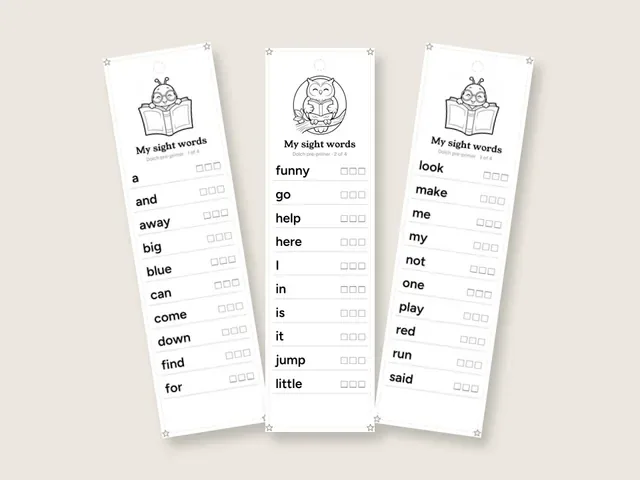
The Dolch pre-primer sight words page has all 40 as four bookmarks of ten words with three tick boxes beside each word. The same page has flash cards, worksheets, bingo cards and a tracing sheet, free for US Letter and A4. The bookmarks suit the week plan, because one tick per clean read tracks the three piles on one strip. Skip the set for a child who already reads the 40 and is ready for the next Dolch list. Skip the worksheets for a 4-year-old who is still learning letters.
Phonics and sight words together
Sight words sit inside phonics, and the Iowa Reading Research Center says sight word instruction must be accompanied by phonics instruction. In the Common Core, RF.K.3 is the parent standard: "know and apply grade-level phonics and word analysis skills in decoding words." Reading high-frequency words by sight is item c under it. Teach the 40 as words with a regular part and an odd part, so the child uses the phonics they already have.
In practice, that means saying the sounds for every regular letter even in an irregular word. For come, the c and the m are what they should be, and the o and the silent e are the trick to point at. For where, the wh starts like when, and the rest has to be remembered. A child who guesses words from the first letter and the picture is skipping this step. Cover the picture for one line and ask for the sounds.
The second standard, RF.K.4, asks children to read emergent-reader texts with purpose and understanding. The sight words are there to serve a real page. After each week's four, find a short book that uses them and read it twice. The adult points the first time and the child the second.
Reading them, then writing them
Writing a word is harder than reading it, so put writing second. A child reads a word cleanly on two days before tracing it. The order after that is trace, copy, write from memory. Tracing a word three times on handwriting lines and copying it once beside the model takes about two minutes. Two words a day fits inside the five minutes.
The tracing sheet on the pre-primer page shows every word three times in gray on handwriting lines, six words to a page. Plain lined paper with the word written at the top by an adult does the same job, and for a child who hates worksheets it does it better. If a 5-year-old is also doing name writing practice, the same lines and the same grip serve both. A child whose pencil grip is still a fist should trace sight words with a finger first and keep the pencil for the name.
Games for a group or a class
Games carry the review pile. A child will read the same 40 words ten times inside a game and balk at ten flips of a card. For one child, the hunt and the act-it-out rounds from the table are enough. For a small group or a class, bingo is the usual choice. Call a word, every player finds it and covers it, and five in a row wins.
The bingo card generator has the 40 pre-primer words as a ready list. It makes up to 30 shuffled 5 by 5 cards with a free center, each holding 24 of the 40 words in its own order, plus a calling list. For two players at home, bingo is the wrong tool. Both cards fill at almost the same pace and the game is over in a few minutes, so use the hide-and-find hunt instead. More games for one child, a small group or a class are in sight word games.
Mistakes that slow the list down
The slowest route through the 40 is a full stack of cards and a nightly test. The five habits below each add weeks, and each has a fix that costs nothing.
- All 40 cards on day one. A 5-year-old gets nothing to feel finished with. Four a week and a done pile fix that.
- Testing instead of reading. A card flipped and marked wrong five times teaches a child to dread the card. After a 3-second pause, say the word, move on, and leave the card in the new pile.
- Letting the picture do the reading. A child who reads "the dog ran" from a picture of a dog has not read ran. Cover the picture for one line.
- Teaching b and d words side by side. A child who flips the two letters reads dig for big. Big and blue come in weeks 6 and 7, and down waits until week 9 on purpose.
- Dropping the done pile. Words leave as fast as they arrived without a weekly pass through the pile.
Where is a special case. It comes last in the plan because wh plus an ere that sounds like air gives a 5-year-old two odd parts in one word. Give it the whole of week 10 if it needs it.
How to tell a word is learned
A word is learned when the child reads it inside a sentence, without a pause, on two different days. The card alone is no proof, because the card is always the same shape in the same marker. In a book, the word arrives in a new font next to new neighbors, which the card never tests.
So the weekly check is short. On Thursday, and again the next Monday, open any book that holds the week's four words. The child reads the line each word sits in. A word read cleanly both times goes in the done pile. A word with a pause or a guess goes back in the new pile and returns the next week beside the new four. Three weeks later, pull five cards from the done pile and find them in a book again. Any that have slipped go back to the start.
Questions
How many sight words should a kindergartner know?
There is no national count. The Common Core kindergarten standard asks for common high-frequency words read by sight and gives 10 examples, and Understood.org notes that schools set their own expectations, so ask for your school's list. The 40 pre-primer words are a workable goal for the year.
What should a 5-year-old be able to read by sight?
By the end of kindergarten, the Common Core standard expects words such as the, of, to, you, she, my, is, are, do and does read by sight, plus emergent-reader texts read with understanding. A 5-year-old at the start of the year may read none of them yet, and that is where the week plan begins.
Do sight words replace phonics?
No. The Iowa Reading Research Center says sight-word instruction must be accompanied by phonics, and in the Common Core, reading words by sight is one item under the phonics standard RF.K.3. Sound out the regular letters in each word and point out only the odd part.
Sources
- Common Core State Standards Initiative (thecorestandards.org), English Language Arts Standards » Reading: Foundational Skills » Kindergarten (2010) (last checked 2026-10-13)
- Idaho State Department of Education, Kindergarten Essential Standards Quick Guide (2024) (last checked 2026-10-13)
- Iowa Reading Research Center, University of Iowa, Teaching Sight Words as a Part of Comprehensive Reading Instruction (2018-06-12) (last checked 2026-10-13)
- GreatSchools Editorial Team, Dolch sight word nouns: preK-3rd grade (2024-05-17) (last checked 2026-10-13)
- Understood.org, What are sight words? (2019) (last checked 2026-10-13)