Name Writing Practice for Preschool and Kindergarten
Your 4-year-old can hold a crayon, knows the first letter of their name and wants to write the whole thing. Name writing practice runs in three levels, tracing, copying and writing from memory, with the capital first letter learned before the lowercase rest. Each level takes about five minutes a day, and the child moves up when the current level looks easy.
Why name writing practice comes before other words
The name is the right first word because the child already cares about it. The University of Nevada, Reno Extension notes that children usually learn to write their names before other words. The Head Start Early Learning Outcomes Framework adds that preschoolers take pride in recognizing their name in print and practice writing it.
Between 36 and 48 months, the framework says, writing is mostly drawing and scribbling, and with modeling and support a child produces some letter-like forms and letters. Between 48 and 60 months, children use drawing, scribbling, letter-like forms and letters to convey meaning on purpose. By 60 months the indicator is a first name written correctly or close to correctly. A 3-year-old tracing one capital and a 5-year-old writing "Mia" from memory are both on schedule. Pick the level by what the child can do this week, never by birthday.
Start with the first letter, as a capital
Teach the capital first letter on its own before the whole name. It is the letter the child already points at on cubbies and birthday cards. Most capitals are a few straight or round strokes, so a 3-year-old can manage an M or a T with a chunky crayon. Write it about 2 inches tall and let the child trace it with a finger first.
Say the strokes aloud as you draw, "down, down, across" for an H. The child draws it in the air, then on paper. One letter a session is enough. Once that capital is steady, add the second letter in lowercase right away. A name learned in all capitals has to be unlearned in kindergarten. A child who can write the B of "Ben" has done the biggest letter, and the lowercase e and n are two short strokes each.
Tracing the name, the first level
Tracing teaches the shape and the stroke order before the hand can produce them alone. Write the name in yellow highlighter or in dotted lines, about an inch tall, and let the child go over it with a crayon or a thick marker. Three traces a day is plenty. Watch where each letter starts, since that matters more than how neat the result looks.
Make the model by hand, in the print style the child's school uses, and put a small dot where the pencil goes first on each letter. Most capitals begin at the top, and that habit is far easier to build at 4 than to fix at 7.
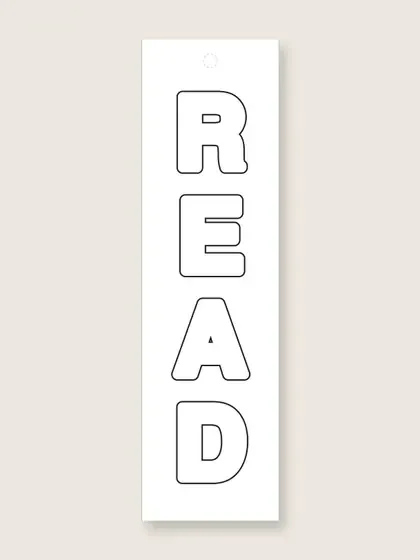
Our free Name bookmark maker prints up to four names of up to 10 letters as thick outlines on 2 by 7 inch bookmarks, to color in and trace around. It shows a child who cannot yet see "Sofia" as one word how the letters sit together. For stroke practice it is the wrong tool, because rounded bubble letters have no start dot and no stroke order. The bookmark goes on the fridge, and the highlighter model stays in the lesson.
Copying from a model, the second level
Copying asks the child to look at the name and make it on the line below, letter by letter. Write the model once at the top of the page and rule rows about an inch apart under it. Expect the first copies to run uphill, with the last two letters squeezed at the edge. That is normal at 4 and fixes itself with a baseline and a start dot for each letter.
Check two things per session, the order of the letters and whether each starts at the top. Size and spacing come later. Two copies a day, and the child circles the better one. If one letter keeps coming out wrong, go back to tracing that letter alone for a day or two, and let the rest of the name wait.
Writing from memory, the third level
Writing from memory is the goal of the whole exercise, and the only new equipment is a fold. Fold the model under, ask for the name, then unfold and compare. Let the child find the differences, which teaches more than you pointing at them. One attempt from memory a day, then one copy to repair whatever slipped.
Spelling aloud helps here. A child who can say "M, i, a" in order has a plan for the pencil before it touches the paper. The Nevada extension's conventional stage of writing includes spelling the name and other words correctly, so the pencil and the spelling arrive together. A 5-year-old who writes the name at the top of every drawing without being asked has arrived, whatever the letters look like.
Lowercase letters, and what comes after the first name
Lowercase is where most of the work sits, because the 26 small letters come in three heights and a few of them mirror each other. Group them by height instead of alphabet order. Short letters such as a, c, m, n and o come first, then tall ones such as b, d, h, l and t, then the five with a tail, g, j, p, q and y. A dashed midline on the practice row shows where the short letters stop.
Expect b and d to swap places for a while. Say it once, mark it lightly and move on. The last name follows the same three levels once the first name is automatic.
Joined cursive letters come years later. Our free cursive generator is the wrong choice for a 4-year-old, since its page pitches even the medium rows at second and third graders. For a second grader with steady print, it prints the name as a tracing worksheet or as four name bookmarks, each with a dotted copy and a blank row.
A five-minute practice session
Five minutes is long enough for a child aged 3 to 6 to improve and short enough to end before the hand tires. Run it the same way every day, one sheet and one crayon at the same table, so the child knows what comes next.
- Say the name together and count its letters on fingers. Find the first letter somewhere in the room.
- Finger-trace the model while you say each stroke aloud.
- Trace, copy or write from memory once, whichever level the child is on.
- One more try. The child circles the better of the two.
- Write the name on something real, today's drawing or a lunch note.
Stop at five minutes even on a good day, because the child remembers the ending. If an older sibling wants in, give them the same name to draw as graffiti-style letters for older siblings. A 9-year-old busy at the same table makes it easier to keep a 4-year-old in the chair.
Mistakes that slow a child down
The most common mistake is correcting every letter. The Nevada extension asks adults to accept all levels of children's writing, including spelling and grammar errors. Name the one letter that improved since yesterday and leave the other four alone. A child who hears five corrections in five minutes stops bringing you the paper.
The second is size. A worksheet with half-inch letters suits a 6-year-old and defeats a 3-year-old. Go to 2-inch letters or bigger, and shrink them over months. The third is the all-capitals name, quick to teach and slow to undo. The fourth is a session that runs to 15 minutes because it was going well. The letters get worse in the last five, and those are the ones the child sees last.
Signs a child is ready for the next level
Move from tracing to copying when the crayon stays on the model for three sessions in a row and the child starts each letter at the dot without a reminder. Move from copying to memory when the copy has every letter in order and the child glances at the model once per letter or less.
Move on from the first name when it comes out right from memory on three separate days. Three tries on one afternoon do not count. The other sign is a name that shows up on drawings nobody asked to be signed. That is the indicator the Head Start framework sets for 60 months, a first name written correctly or close to correctly, and close counts.
Sources
- Office of Head Start (HHS/ACF), Head Start Early Learning Outcomes Framework: Ages Birth to Five (2015) (last checked 2026-10-13)
- University of Nevada, Reno Extension, Stages of Emergent Writing (Byington and Kim, 2014) (last checked 2026-10-13)