What Book Should I Read Next? Six Ways to Decide
Start from the one thing you know for certain right now, whether that is your mood, the evenings you have free this week, or the book you just finished and already miss. Each of the six ways below turns that one fact into a shortlist of three titles, and you read the first page of each before you decide. If you keep asking what book should I read next and end up rereading an old favorite, the list you already keep is the place to look.
Choosing goes faster when you decide where to look before you look. Match your situation to one of the six ways, and give it 10 minutes at most.
- You want something and cannot say what, so ask your mood for three words.
- You have a week of short evenings, so choose by length first.
- You just closed a book you loved, so look for one trait of it in the next.
- A friend keeps saying you have to read this, so take the pick, on one condition.
- You are standing in a library or a bookshop, so pull three books off the shelf.
- Your list of books to read has 20 titles on it, so go back to the list.
Ask your mood what book to read next
Write down three words for what you want from the next book, before you look at a single cover. Comfort, speed and somewhere far away is one set. Slow, strange and sad is another. Three words rule out most of the shelf, which is the point. A wide-open choice is what sends most of us back to an old favorite.
The ALSC blog on readers' advisory suggests one question that does the same job for any age: "Do you like reading about real or imagined things?" Answer it and half the library is gone. Add two words for the feeling you want, and carry all three into whichever way you use next.
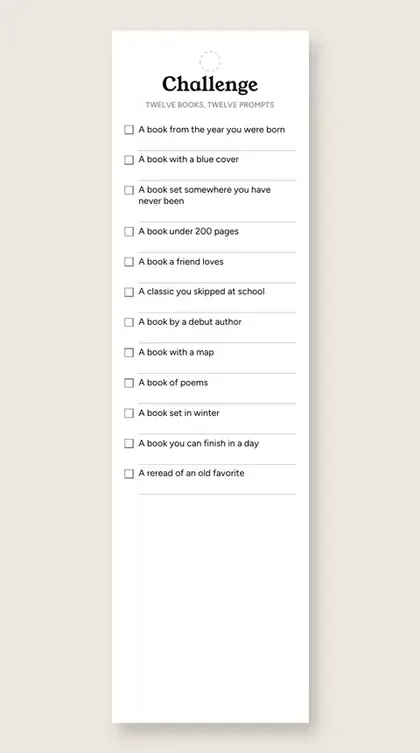
When no mood turns up at all, let a prompt decide. A challenge that picks for you works because the prompt is specific and you did not choose it. Our free challenge bookmark on the reading trackers page has 12 prompts, among them a book under 200 pages and a classic you skipped at school. If your list already holds 20 titles, skip the prompts. They add books, and you need fewer.
Choose by the time you have
Count the free evenings before the next busy stretch, and let that number set the page count. At 20 pages an evening, a 300-page novel takes 15 evenings and a 600-page one takes a month. Nothing is wrong with the long book, except that it will still be half read when the holiday ends. A half-read book is the one that stops people reading at all.
Decide the ceiling before you shortlist. Under 200 pages for a week with two free evenings, under 350 when you have most nights, anything at all for a vacation. Page counts are in the library catalog and on the copyright page. Short books also carry less risk, since a wrong pick costs two evenings instead of twelve.
Collections of stories or essays fit a broken week in a way a novel cannot. You can stop at the end of any piece without losing the thread. Keep one on the nightstand for the weeks when the novel is not getting opened.
Start from the last book you loved
Name the one thing you loved most and look for that, since a book with the same plot rarely has the same feeling. Was it the voice, the place, the pace, the way the chapters ended? Write that one trait down. Another book about a lighthouse leads to a worse lighthouse. Another book told in letters leads somewhere.
Librarians call this readers' advisory and have tools for it. The Public Library Association's readers' advisory resources include a tool called What Should I Read Next?, which takes a book you liked and suggests a next read. The ALSC blog makes the same point about people. A librarian does not need to have read every book, because they "can use skills and tools to give our patrons choices." Take your one trait and the title to the desk and ask for three.
Read the back cover last. It describes the plot, which is the part you are least likely to want again.
Take a friend's pick, on one condition
Say yes to the friend, on the condition that they tell you why. Ask what they liked about the book, and ask for a scene. A friend who can name a scene has read the book; a friend who says everyone is reading it has read the reviews. The reason also tells you whether the book fits this month or a later one. That saves you from starting a slow, sad novel in the week you wanted comfort.
Write the friend's name next to the title wherever you keep your list, so a good pick gets thanked and a bad one weighs less next time. After three picks from the same person you know whether your tastes overlap, and that is worth more than any review.
A club is a friend's pick at a larger scale. What other readers in a club pick comes with a date to finish by and a room of people who read the same pages. It is the one way of choosing that also gives you someone to talk to afterward.
Browse a library shelf
Go to the shelf, pull three books, and read the first page of each standing up. Ten minutes is enough. The first page shows the voice, the sentence length and whether the writer trusts you, which is more than a cover tells, and putting it back costs nothing.
The ALSC blog describes a librarian stepping away from the desk to browse the shelves and coming back with several options for the reader. Do the same for yourself. Start at the author you last loved, since fiction shelves run alphabetically and the neighbors are a lucky draw. Then move to the new-arrivals display, where someone has already done one round of choosing for you.
If you are choosing for a child, let the child pull the three books, even when one looks too easy, since the aim is that they enjoy it. The National Literacy Trust reports that children who enjoy reading benefit in reading skills, aptitude for learning, and wellbeing and empathy. Its 2026 survey of 125,375 UK children aged 5 to 18 found that 36.1% of 8-to-18-year-olds enjoy reading in their free time. Of those who enjoy it, 49.8% read regularly in their free time, against 4.5% of those who do not.
Go back to your TBR list
Open the list of books waiting and read it from the top, because the next book is usually already on it. A title you wrote down three months ago has passed a test that nothing on the new-arrivals table has passed. You still remember why you wanted it. Pick the three you can explain and drop the ones you cannot.
Keep the list where you read, with the reason beside each title. Where you heard about a book is the column most people skip and the one that helps most now. A friend's name and the trip where they mentioned it tell you more in March than the title does. The notes app on a phone works, and so does the back page of a notebook.
If you would rather have it on paper, our free TBR list printable is one page with 40 rows: a checkbox, the title, the author and where you heard about it. Folded in thirds it rides inside the book. A reader with 4 titles waiting does not need 40 rows, and a sticky note on the fridge does that job.
When a title has sat on the list through three choosing rounds and lost every time, cross it off. It was a wish, and the row is worth more to the next book you hear about.
Sources
- National Literacy Trust, Reading for pleasure (2026) (last checked 2026-10-13)
- ALSC (American Library Association), Two Simple Tricks for Reader's Advisory (2024) (last checked 2026-10-13)
- Public Library Association (ALA), Readers' Advisory resource list (n.d.) (last checked 2026-10-13)