How to Read Faster Without Losing the Story
The average adult reads silently at about 238 words per minute for nonfiction and 260 for fiction, by a 2019 review of 190 studies. You can learn to read faster than that, and the method that holds up in the research is daily practice and a bigger vocabulary. No app or course takes a reader past about 1,000 words a minute with the story intact, so the question for each method is what it costs in understanding.
The average reading speed, in words and in pages
The 2019 review by Marc Brysbaert pooled 190 studies with 18,573 participants. It put the average adult silent reading rate in English at 238 words per minute for nonfiction and 260 for fiction. Reading aloud is slower, 183 words per minute across 77 studies. The gap between fiction and nonfiction, he found, can be predicted from the length of the words.
The 238 and 260 averages sit below the figures that circulate in reading courses. The BPS Research Digest write-up of the review calls a target of 300 words per minute unrealistic for the majority of people. The study averages ran from just over 100 to nearly 400. Children, older adults and people reading English as a second language come in lower still.
In pages, plan on about 275 words a page for a mass-market paperback. That puts the average adult at roughly 52 to 57 pages an hour. Is 20 pages an hour slow? On that page it works out to about 90 words per minute, or 100 on a hardcover with 300 words a page, which is slow against the averages. A textbook with long words and diagrams pulls everyone down, though, and a reader who stops to look things up is doing more than reading.
A hundred pages an hour is about 460 words per minute, above the fastest study average in the review. At that pace you are skimming, whatever the app calls it.
Speed-reading apps and the one-word-at-a-time trick
Most speed-reading apps use rapid serial visual presentation, RSVP for short. The review by Rayner and colleagues describes it as a technique that presents one word of text at a time, in one spot on the screen. The pitch is that your eyes no longer have to move, so the time they spent moving goes to reading.
The Association for Psychological Science summarized that review. Eye movements account for no more than 10% of the time we spend reading, so removing them cannot buy a large gain.
What the flashing word also removes is the chance to look back. Rayner's team found that taking away eye movements and rereading generally impairs recall of material shown at faster speeds. In ordinary reading you glance back at a name or a clause you half caught, several times a page, without noticing. On an RSVP screen that option does not exist, and the half-caught clause stays half caught.
Brysbaert's review draws the hard line. Reading rates above 1,000 words per minute are impossible without severe loss of text understanding. An app that reports 800 words per minute is reporting how fast the words appeared. How fast you read them is a different number. For a 12-page report you must have seen before a meeting, an app set to 350 words per minute is a usable tool. For a novel it mostly replaces the story with the memory of having seen the words.
Skimming on purpose
Skimming is the fastest reading method that is honest about what it does. You read the headings, the first sentence of each paragraph and any line with a number or a name you need. You skip the rest. The APS release calls the general pattern a trade-off between speed and accuracy. Rayner's review states it plainly: an increase in reading speed is accompanied by a reduction in comprehension of the material. You accept that trade when all you need from the text is a decision.
Skimming works where the text has structure to lean on, such as a report, a manual, a textbook chapter with a summary at the end, or an email thread with 30 replies. Read the first and last paragraphs in full, then the first line of everything in between. You leave with the argument and the main figures. If one paragraph turns out to matter, read that one properly and move on.
Skimming fails on fiction, because a novel keeps its information in the places skimming skips. The clue in a mystery sits in the middle of a paragraph of description. A character's change of heart lives in one line of dialogue. Skim a 300-page novel and you reach the ending with the plot and without the reasons for it.
The same goes for anything you will be tested on or asked to explain. When the book is a novel you chose for pleasure, the honest route to finishing sooner is a shorter book or more minutes a day.
Reading practice and a bigger vocabulary
The APS release, after setting the shortcuts aside, names the one method that works: practicing reading for comprehension. The mechanism shows in the Brysbaert review. Fiction reads faster than nonfiction, 260 against 238 words per minute, and the difference can be predicted from word length alone. Short words are mostly familiar words. Every word you recognize on sight is a word you no longer have to work out.
The practical side of building that vocabulary is modest. Read every day in the same slot, for a set number of minutes such as 20 or 30. Minutes are easier to keep than pages when the book turns hard. Choose books a notch easier than your limit for the daily slot and save the hard one for the weekend. Speed grows on text you can take in a sentence at a time.
When a word stops you, mark it in pencil and look it up at the end of the chapter. The chapter keeps moving, and you end up with a list to learn from. A speed gain only holds if the understanding holds with it, and understanding what you read has its own habits before, during and after the book.
The methods compared
| Method | What it changes | What the sources say about comprehension |
|---|---|---|
| RSVP apps, one word at a time | Removes eye movements and the chance to look back | Rayner et al. 2016 found that removing eye movements and rereading generally impairs recall at faster speeds. Brysbaert 2019 puts severe loss of understanding above 1,000 wpm |
| Courses that train the eyes to take in more at once | Targets the time spent on eye movements | APS 2016 says eye movements are no more than 10% of reading time, so the gain is capped there |
| Skimming | Reads the structure, skips the body | Rayner et al. 2016 found that faster reading comes with reduced comprehension. Fine when a decision is all you need |
| Daily reading practice | Makes more words automatic | APS 2016 names practicing reading for comprehension as the reliable way to improve |
| Building vocabulary | Shortens the time each word takes | Brysbaert 2019 explains the fiction and nonfiction gap by word length |
For a fact from a document, skim it. For more books a year, read daily and measure every few weeks. Skilled readers already average 200 to 400 words per minute by the APS figures. A gain that moves you up inside that band is a real result, and it comes from the bottom two rows.
How to read faster in practice
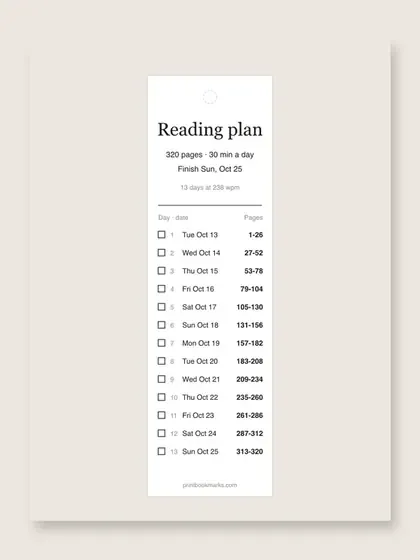
Start by measuring your speed on the kind of text you want to read faster, with the method in the last section. Write the number down with the date. Then pick the next book a notch below your limit. A 320-page paperback at 275 words a page is about 88,000 words. At 238 words per minute that takes about 6 hours and 10 minutes, or 13 days at 30 minutes a day.
The free reading time calculator does that arithmetic from the page count and the kind of book, at the 238 and 260 averages or at your own speed. It prints four reading plan bookmarks with the pages for each day. For a child, its presets are about 100 words per minute for grades 2 to 3 and 150 for grades 4 to 6. A measured number beats a preset. By hand, it is pages times words per page, divided by words per minute, then divided by your minutes a day.
The plan suits a set text with a deadline and a reader who likes ticking boxes. If a finish date would turn the book into homework, skip the plan and keep only the daily minutes.
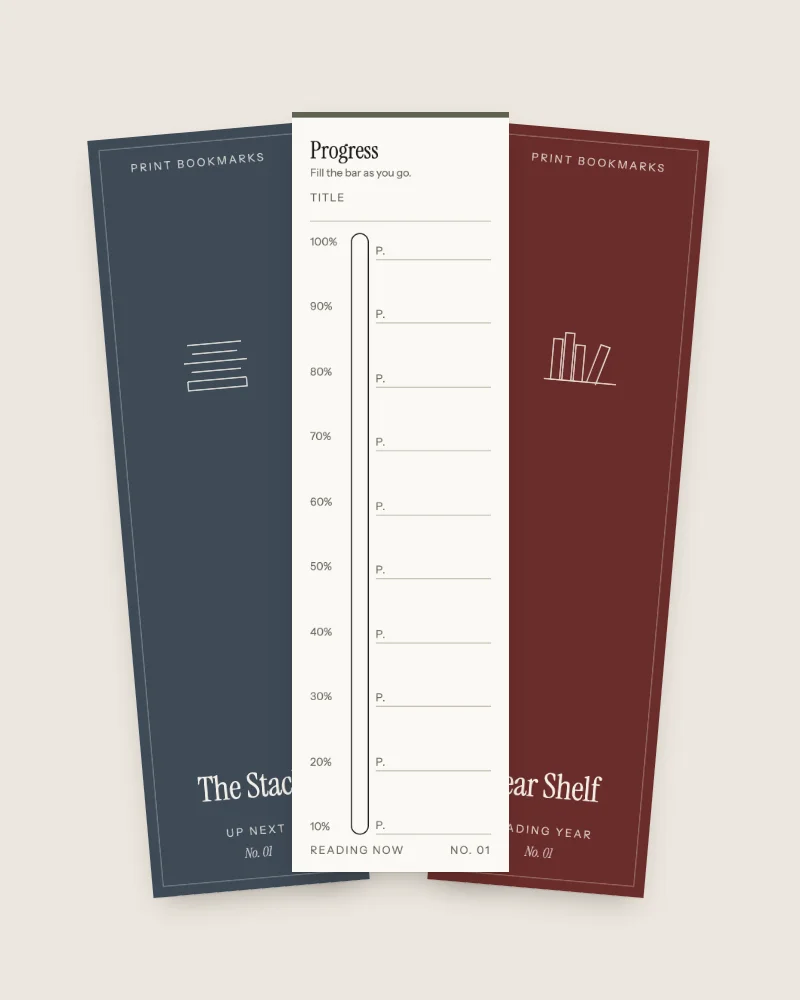
Keep the daily slot for a month before you judge the method, since one week shows nothing. Over a year the extra minutes add up. A sheet where you keep a year-long count shows whether they became extra books.
Measuring your speed before and after
To measure by hand, take the book you are reading, note the page, and read at your normal pace for exactly 5 minutes by a timer. Count the pages you covered and multiply by the words on one full page (count them once, or use 275 for a paperback and 300 for a hardcover). Divide by 5. Then close the book and retell the passage in three sentences, or have someone ask you three questions about it. Without the retelling, the number only says how fast you turned the pages.
Our free reading speed test does the same with three Project Gutenberg passages. An Aesop fable of 355 words is the passage for grades 2 to 3. The opening of Black Beauty, 396 words, is for grades 4 to 6, and the start of A Christmas Carol, 378 words, is for teens and adults. You press Start, read, press Done, and answer three questions without looking back at the text. Results stay in your browser in a speed log you can print, and the number goes straight into the calculator.
The test is the wrong tool for a textbook or a work report. The passages are classic fiction, and your speed on them will not be your speed on a manual. For that, measure by hand on the manual itself.
Repeat the measurement every few weeks on the same passage level or the same kind of book. Keep only the results where you answered at least two of the three questions right.
Questions
How many pages an hour is a normal reading pace?
At the adult averages of 238 to 260 words per minute, and about 275 words on a paperback page, an hour covers roughly 52 to 57 pages. Twenty pages an hour is about 90 words per minute on that page, below the slowest study averages in the 2019 review, which were just over 100.
Can an app get you to 1,000 words a minute?
An app can flash words at that rate, but the 2019 review by Brysbaert states that reading above 1,000 words per minute is impossible without severe loss of understanding. Rayner's 2016 review found that taking away eye movements and rereading generally impairs recall at faster speeds.
Are fast readers born that way?
Reading rates vary widely, from just over 100 to nearly 400 words per minute across the studies in the review, and they are lower for children and for people reading in a second language, so the rate grows with years of reading. The method that reliably raises it, per the Association for Psychological Science, is practicing reading for comprehension.
Sources
- Marc Brysbaert (Ghent University), How many words do we read per minute? A review and meta-analysis of reading rate (2019) (last checked 2026-10-13)
- BPS Research Digest (Matthew Warren), Most comprehensive review to date finds the average person's reading speed is slower than previously thought (2019) (last checked 2026-10-13)
- Association for Psychological Science, Speed Reading Promises Are Too Good to Be True, Scientists Find (2016) (last checked 2026-10-13)
- Association for Psychological Science, Psychological Science in the Public Interest (Rayner et al.), So Much to Read, So Little Time: How Do We Read, and Can Speed Reading Help? (2016) (last checked 2026-10-13)