Reading journal bookmark: what to log
Log the title, a page, and one line you want later. A reading journal bookmark is that short record plus a response. Fill it before you close the book, then get back to the page.
What should you log?
The note has to name the book after the week is gone, and it has to point you back to one moment. Title and author do the first job. A page or chapter cue and one line do the second. If either job fails, the strip is a scrap. A date is worth the space only when you will look it up. A rating is worth it only when you will still know what the mark means. A word or a private mark is enough. The line is the reason you kept the strip. Use a short quote, a question, or what changed in a character. Where the book came from matters only if you may want that shelf or person again. A library, a friend, a shop, or a club is enough. Skip any field you will not fill.
Rule the strip in this order:
- Write the title and author on the top row. If the title is long, shorten the author, not the writing row.
- Put started or finished under the title, and only if you will check it.
- Leave a short row for the page or chapter cue.
- Leave the widest row for the line.
- Add where the book came from at the bottom, or skip it.
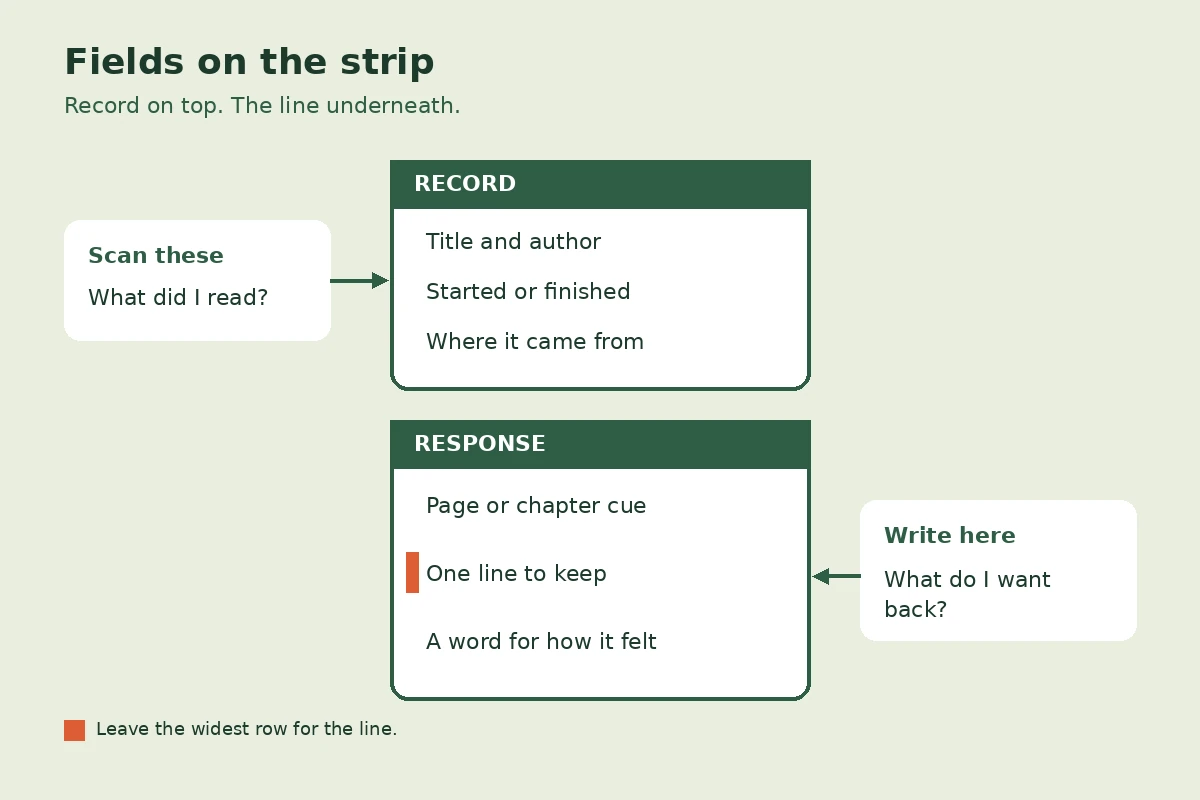
The diagram stacks the record above the line you want to keep.
A filled strip can read like this:
Pride and Prejudice. Jane Austen. Finished in winter. Page cue: the page I marked near the end. Line: I wanted that scene to last, and the chapter moved on. Source: the library hold shelf.
Check your own strip the next day. If you cannot tell which book it is, the title is too thin. If you cannot find the passage, the cue is too vague. If the line could fit any book, it is too broad. Fix those and the strip will still make sense later.
When you pick the book up again, read the line before you find your place. If the line still names the book, you can go on. If it does not, fix the cue, not the title. A stopped book can keep the same strip. Write one line about why you paused, and leave the strip in the book. The next time you open it, that line tells you whether to continue or let it go.
How does a journal differ from a log?
A log records what you read or how far you got. A journal keeps a response as well. Title, date, and a page can live on both. The journal adds a question, a passage, or a personal connection. It can also hold a change in how you see the book. On a bookmark, keep the record short and give the spare room to that response. Use a log when you want a list of finished books. Use a journal line when a passage gives you something to keep. You do not have to pick one method for every book. A light mystery can stay a log. A novel that unsettles you earns the extra line. The top rows answer what you read. The wide row answers what you want back.
Try this order on a novel: what you expected, the passage that stood out and why, then what you think now. Use a question or a personal connection, and leave the class assignment behind.
How do you pick one line?
Pick the prompt before you close the book. A wide question is hard to answer when you are tired. Tie the prompt to the scene you just left. A short quote keeps the wording you want to remember. A paraphrase keeps the idea in your own voice. Put a page or chapter cue beside it so you can find the moment again. If the thought needs a paragraph, keep one phrase on the bookmark. Move the rest to a notebook. The line should bring the scene back. It should not retell the chapter. Stop when the scene comes back without the book in your hand.
Try one prompt, not all of them:
- What changed in this scene?
- What felt familiar?
- What would you ask the author?
- What line would you tell a friend?
A weak line retells the plot. A useful line names a reaction you would lose. "The sister left town" could fit a dozen books. "I wanted her to stay, and the book did not" still makes sense next winter. Use that test. If the line needs the chapter open beside it, it is a summary, not a note.
Write the quote only when the wording itself matters. Otherwise put the idea in your own words, and keep it short. If you marked many passages, choose the one you would mention first. Leave the rest in the book.
What should you leave off?
Leave off any field you never fill. Save the writing area for a note you care about. Skip the plot summary and the long review. Skip the list of every line you marked. Move a thought that needs room into a notebook or a digital note. Keep a page cue, a quick reaction, or a reminder of what to notice next. For a club book, the next question may matter more than a private rating. Let the fields match why you are taking notes. Do not keep a blank only to copy a template. Try the layout on the book in your hand. Write the title. Add the detail you often forget. If a field stays empty, drop it the next time you make a strip.
A bookmark cannot hold a full reading response; keep longer thoughts in a separate notebook or digital note.
You close the book once the title, the page cue, and the line are written. Reading Now: current-book tracker bookmarks is the tracker for that log, and you print it at home if ruling the strip is the chore you want gone.
For the books you mean to read next, the TBR bookmark guide covers a short list and how to prune it. For a club meeting, the book club bookmark guide covers the date, the chapters, and a prompt.
Sources
- California State University, Los Angeles, Center for Effective Teaching and Learning (retrieved 2026-09-28)
- Agnes Scott College, Center for Writing and Speaking (retrieved 2026-09-28)