Book club bookmarks
Put the meeting date, the chapters due, one prompt, and a blank note line on each strip. Print those book club bookmarks once per member, so the plan sits in the book.
What goes on the bookmark?
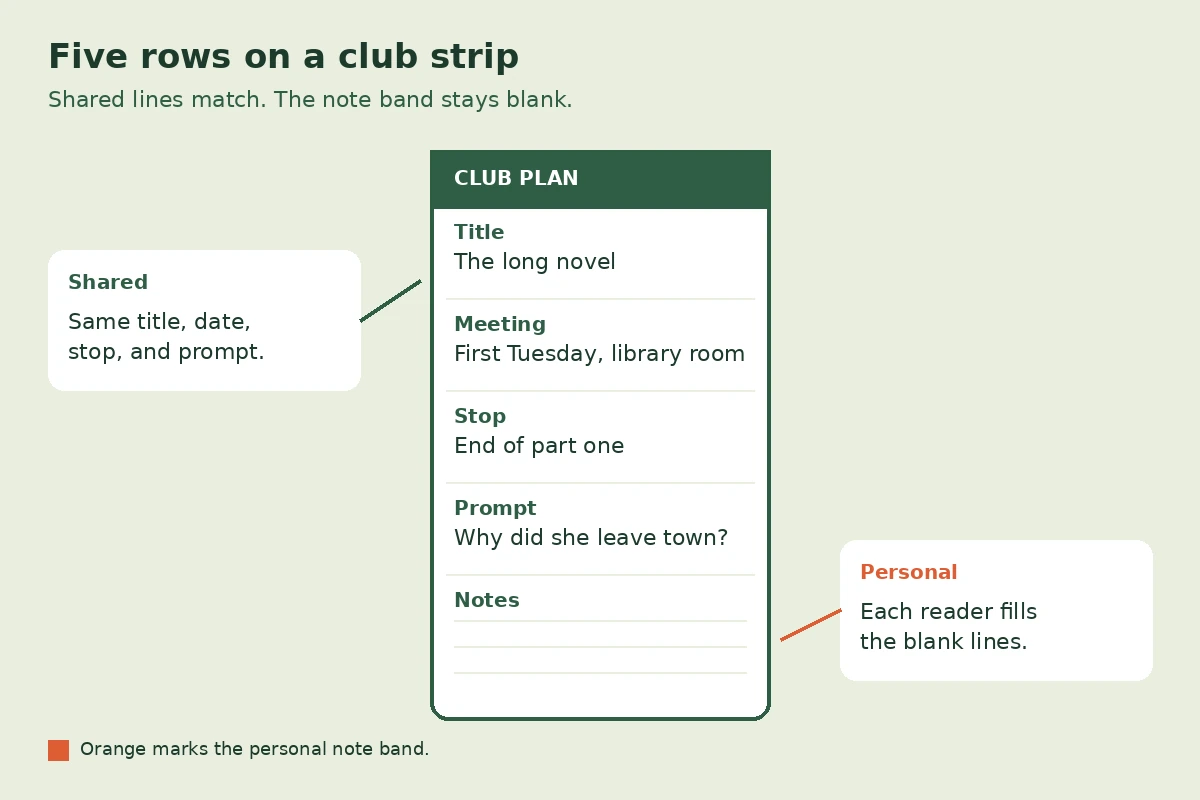
A club strip is the shared plan for one meeting. Write the book title on the top line. Under the title, write the meeting date, the start time, and the place. A chat note is easy to miss on the couch. Open the book and the plan is there. Next, write the stop the group agreed to reach. A chapter, a part, or a named scene is enough. That target keeps the talk on the same stretch. Leave one short prompt. That is the question the leader will ask first. Leave the widest band for notes. Leave it blank when you hand the strips out. Each person fills that band while they read. Skip a rating, a plot recap, and extra questions. If the title runs long, shorten it. Do not shrink the note band to fit the title. The shared lines should match on every copy. The notes should not.
Use these rows on every copy:
| Row | Write this | Leave it |
|---|---|---|
| Title | A short name you will still know next month | Same on every strip |
| Meeting | Date, start time, and place | Same on every strip |
| Stop | The chapter, part, or scene you agreed to finish | Same on every strip |
| Prompt | The first question you will ask | Same on every strip |
| Notes | Nothing, until each person reads | Blank |
Here is a strip after the group has picked the book and before anyone has written a note:
Title: the long novel, shortened to the words you would say. Meeting: first Tuesday, library room, seven in the evening. Stop: end of part one. Prompt: what changed after she left town? Notes: three blank lines.
Agree on one chapter, part, or scene before you print. Read that stop out loud. If two people name different scenes, fix the line, then print the set.
Discussion guides include a summary for leaders, similar titles, and discussion starters. Read the summary before you lock the stop point. If the summary shows the group chose the wrong book, change the book. Do not print a date for a title nobody wants.
How do you pick the prompt and notes?
Pick the prompt before you print. It is the first question you will ask, not a quiz. A discussion guide often starts with a short summary and a few starters. Take one starter that fits this meeting. If the guide offers a pile, keep one on the strip. Put the rest on a handout for the person leading. One question at a time is enough in a living room. A useful prompt names a change, a choice, or a passage. It should still make sense if someone is a little behind. Skip a question that only works when everyone loved the book. Notes belong to the reader. While you read, mark a passage that struck you, or a line you did not follow. Copy a few words onto the strip. Add the page or the chapter beside them. Bring that strip to the meeting. A long reaction belongs in a notebook. The strip keeps a cue you can say out loud.
Try this order when you choose the prompt:
- Read the starter list, or the questions at the back of the book.
- Keep the one you would ask if the room went quiet.
- Drop any question that needs a twist from the unread ending.
- Place the chosen question in the prompt row.
- Put spare questions on a handout or on cards.
A handout can name the main people and give a short plot reminder, so the bookmark does not have to.
For each passage you jot down to take to the meeting, a page number plus a few words is enough. You are reminding yourself, not writing a review. If the cue only makes sense with the chapter open, it is too thin. Add the word that made you stop.
How do you print a set?
Count the people who said they would come. Print one strip for each of them. Add a spare for a guest or a lost copy. Type the shared lines once. The date, the place, and the stop should match on every copy. Leave the note row empty. Print a single test page first. Check that the type is large enough to read in the book. Only then print the rest. Use card you can write on with an ordinary pen. Cut the strips apart. Hand them out when the group picks the book. Do not wait for the night you meet. A stop point does no good if it arrives after the reading is due. Do not guess the sheet count from a screen preview. Check how many strips fit on Letter and on A4 before you print the set.
How many strips fit on a Letter sheet or an A4 sheet, with the margin math, is in the Letter and A4 layout guide. Use that count.
A club bookmark holds the plan for one meeting, not the group's older notes, so keep finished prompts and past dates in a notebook.
A private page cue and a reaction you want later belong on a reading journal bookmark. Do not put them on the strip you hand the group. Titles you might open after this novel belong on a TBR bookmark. This strip names only the club book.
If a next-read tracker is the job you would rather not rule, print Up Next.
Sources
- American Library Association (retrieved 2026-09-28)
- Wyoming State Library (published 2021-10-01; retrieved 2026-09-28)