TBR bookmark: a short list
TBR means to be read. Keep a few of those titles on the bookmark in your current book, and cross one off when you start it.
Where should you keep the list?
Leave the bookmark in the book you are reading now, so the next pick is in your hand when the last page turns. When you start that book, the title leaves the queue. Write the book you intend to open, not the minutes you think it will take. A title you are unsure about belongs in a notebook or an app you will search, not on this strip. A list in another room is easy to skip when a chapter ends on the couch. This one sits between the pages. Move the strip into the next book when you start it. Until then, leave it in the one you just finished, so you do not have to hunt for the queue.
What belongs on the list?
Put a title on the strip only when you can say why it is next. A mood counts, and so does a book it resembles, or a short description that fits this week. If you cannot name one of those, leave the title off. Author and title are enough to find the book later, and the reason sits beside them, short enough to read at a glance. Skip a rating, a page count, and the plot, because you have not read it yet. A club date belongs here only when the meeting is soon and the chapters are already set. Otherwise the date is clutter. When the next title will not fit unless your writing shrinks, stop. Crowding turns a short list into a pile you avoid. A long title can shrink to the words you would say to a friend. You are reminding yourself, not filing a catalog card.
Fast paced and plot driven are moods you can write in a few words. A title you noticed once is not a reason yet.
Fill each row in the same order:
- Write the reason in a few words, before the title.
- Write a short title you will still recognize next month.
- Leave a small mark at the end of the row.
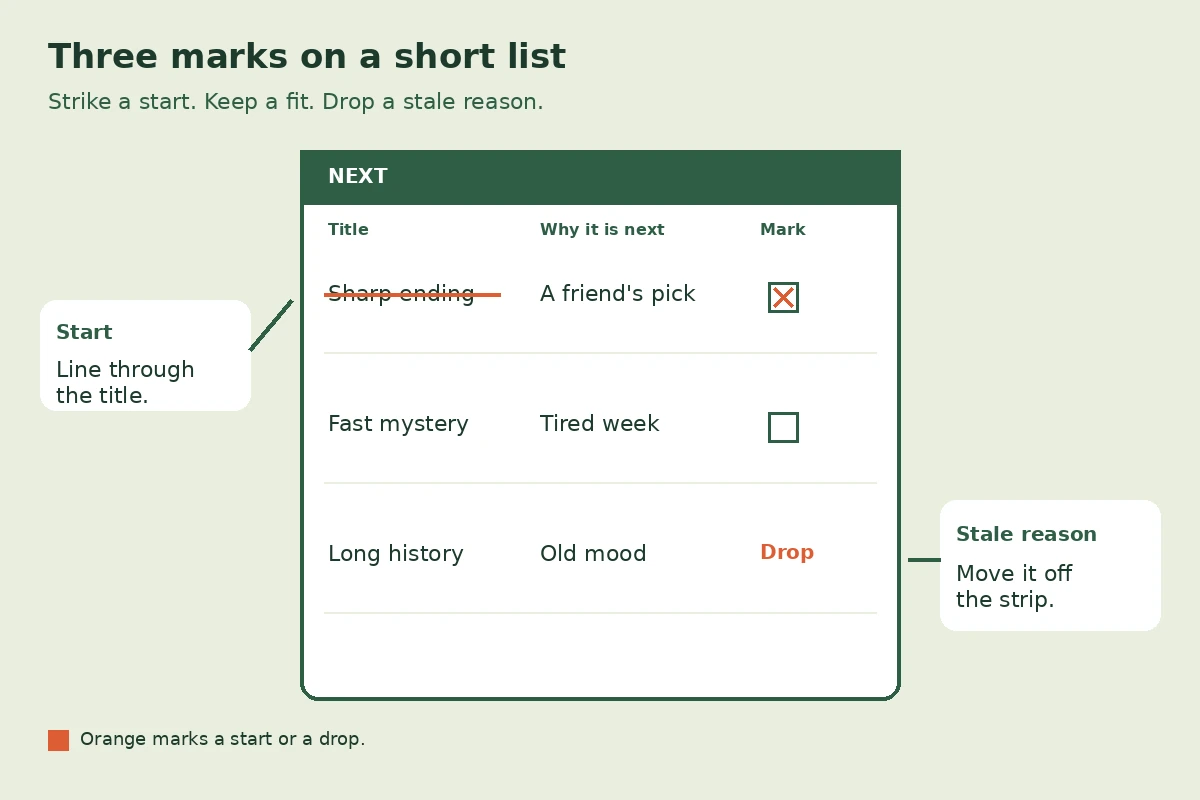
Here is a strip after one start and one cut:
Sharp ending. Reason: a friend said the last chapter bites. Mark: a line through it, because you started it. Fast mystery. Reason: a tired week, and you want the plot first. Mark: keep. Long history. Reason: it sounded right in winter. Mark: drop.
At the last page, read the rows that way. The mystery still fits a tired week, so it stays. The history belonged to a mood you left, so it moves to the longer pile. The struck title does not come back onto the list.
The diagram uses those same three marks. A line crosses a started title. An open row is one you are keeping. Drop sits on a reason that died.
How do you cross a title off?
Cross the title off when you start the book, not when you finish it. Starting is the moment it leaves the queue. A single line through the words is enough, and you should leave those words readable so you do not add the same book again next week. Do not erase the line. A struck title shows you moved. If you quit, leave the line and write stopped beside it, because that word is a warning, not a review. A reaction belongs on a journal strip, or in a notebook. This list answers one question: what is next? When the book in your hand ends, read the titles still waiting before you buy or borrow another, and pick the reason that still fits. If none of them fit, prune before you choose. The line goes on that next title when you start it, not when you close the book in your hand.
Once the book is open, a page and a response belong on a reading journal bookmark. They do not belong in this queue.
When should you prune?
Prune when a reason no longer fits, or when the strip is full and a better title is waiting. A stale reason is a book you would not start this month, so move it off the bookmark. Guilt is a bad reason to keep it. A list you dread is a list you will not open. Read the reasons when you finish a book, keep the titles that still sound like the reader you are now, and drop the ones tied to a mood you left. Add a new title only after a start or a drop. If every reason still fits and you still want every title, stop pruning. A list you trust matters more than a shorter one. A bookmark you avoid has the wrong titles on it, so change the titles and leave your willpower alone.
A short bookmark list leaves out books you may still want later, so keep the longer pile somewhere you will actually search.
The work on this strip is choosing a title, striking it when you start, and dropping a reason that died. Up Next: TBR tracker bookmarks is what you print at home when ruling that queue is not the work you want.
A meeting date and a chapter target belong on book club bookmarks, if the next title is a club book. This strip stays a list of what to open next.
Sources
- Abbreviations.com (STANDS4 LTD) (retrieved 2026-09-29)
- Wyoming State Library (published 2021-10-01; retrieved 2026-09-28)