Bookmark size for A4 and Letter: how many fit?
For a 2 by 6 in bookmark size, a US Letter sheet holds 6 strips and an A4 sheet holds 5. A longer 2 by 7 in bookmark fits 5 on either sheet. Both counts keep a 0.25 in margin on Letter and a 5 mm margin on A4, with the strips cut edge to edge.
How do A4 and US Letter differ?
US Letter is 8.5 by 11 in (215.9 by 279.4 mm), while A4 is 210 by 297 mm. Side by side, A4 is 6 mm narrower and 18 mm taller than Letter. Those two small differences decide the whole layout. The extra width on Letter leaves just enough room for a fourth upright strip, while A4 stops at three. The extra height on A4 leaves a deeper band under the first row, and that band is where the sideways strips go. So a sheet planned for one size never carries over exactly to the other, even though the two look almost the same in the tray. Work out the layout for the paper you actually have, and keep each sheet in its own unit: inches for Letter, millimeters for A4. Converting A4 into rounded inches is how a strip ends up a hair too wide to fit.
A4 belongs to the ISO 216 series, the paper standard in almost every country outside North America, while Letter is still the everyday sheet in the US and Canada. If a pack of cardstock has lost its label, measure the short edge: Letter is 215.9 mm across and A4 is 210 mm.
Should you print at actual size or fit to page?
Print at actual size whenever the file and the paper match, because that is the only setting that keeps each strip at the width it was drawn. The choice gets harder when they do not match. At actual size, a Letter file on A4 runs 6 mm too wide, and an A4 file on Letter runs 18 mm too tall, so an edge can be clipped. Fit to page keeps every edge but shrinks the whole design a little, so every strip comes out narrower than it was drawn. An A4 file fitted to Letter shrinks more than the other way round, so measure one strip on your test sheet before you cut. Choose by what sits near the edge. If the titles and ruled lines stay a few millimeters inside the outer strips, actual size is the better trade. If art or lines run right to the edge, fit to page, or rebuild the file for the paper you have.
Before a run on cardstock:
- In the print dialog, set the paper size to the sheet in your tray, and load it the way the picture on your printer shows.
- Pick actual size rather than fit or shrink. The name varies by app, but the idea is that nothing gets scaled.
- Print one sheet on plain paper and measure the short side of a strip with a ruler.
- If it matches the width you drew, load the cardstock and print the rest.
Here is the Letter-on-A4 case worked through. A Letter sheet of four upright 2 in strips spans 203.2 mm, and A4 is 210 mm wide, so at actual size the strips still fit, with 6.8 mm to share between the two sides. Your test sheet shows whether your printer reaches that close to the edge. If a cut line or a letter is missing on the outer strips, switch to fit to page, or rebuild the file for A4 with three strips across. The height needs no check, because A4 is the taller sheet. An A4 file on Letter loses height instead, so look at the bottom band of the test sheet.
Paper weight, feeding cardstock and cutting straight are covered in the home printing steps. For a tracker with a back, line the two sides up first with the front-and-back steps.
How many strips fit on each sheet?
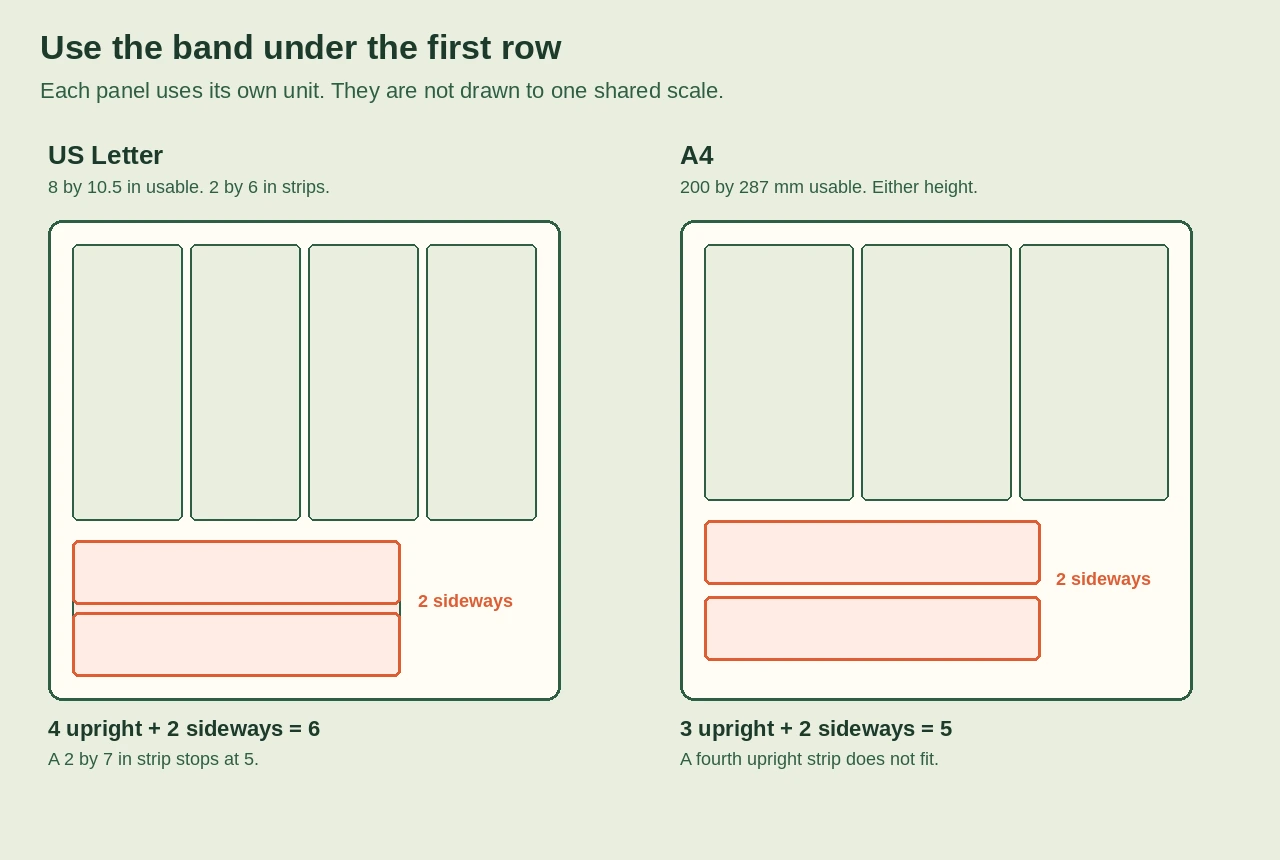
Stand the first row of strips upright across the top of the sheet, then turn the sheet a quarter turn and lay more strips sideways in the band that is left. On Letter, four 2 by 6 in strips fill the 8 in of usable width, and the 4.5 in band below holds two more, for 6. At 2 by 7 in the band shrinks to 3.5 in, which holds only one sideways strip, so the count drops to 5. A4 is narrower: four upright strips need 203.2 mm, but only 200 mm is left inside the margins, so the top row takes three. Its taller band then holds two sideways strips under either length, making 5 bookmarks. On Letter the shorter strip earns an extra bookmark per sheet. On A4 the longer strip costs nothing, so choose the length that suits your books. The tables below show the working for each sheet.
On Letter, work in inches.
| Strip | Usable area | Upright row | Band below | Count |
|---|---|---|---|---|
| 2 by 6 in | 8 by 10.5 in | 4 across | 4.5 in, room for 2 sideways | 6 |
| 2 by 7 in | 8 by 10.5 in | 4 across | 3.5 in, room for 1 sideways | 5 |
On A4, keep the working in millimeters so no rounding creeps in.
| Strip | Usable area | Upright row | Band below | Count |
|---|---|---|---|---|
| 50.8 by 152.4 mm (2 by 6 in) | 200 by 287 mm | 3 across | 134.6 mm, room for 2 sideways | 5 |
| 50.8 by 177.8 mm (2 by 7 in) | 200 by 287 mm | 3 across | 109.2 mm, room for 2 sideways | 5 |
Leave no gap between strips, so each cut trims two edges at once. Cut the upright row free first with a long ruler stroke, then split the sideways band.
These counts assume the margins above and no gap between strips, so a printer that cannot print that close to the edge will fit fewer.
To choose the strip length for the books you read, see what bookmark size to print.
If you would rather spend the sheet on tracking than on ruling lines, All three from Print Bookmarks gives you trackers for your next book, your current book, and the books you have finished.
Sources
- University of Cambridge (retrieved 2026-09-28)
- Microsoft (retrieved 2026-09-28)