The Standard Bookmark Size, and When to Change It
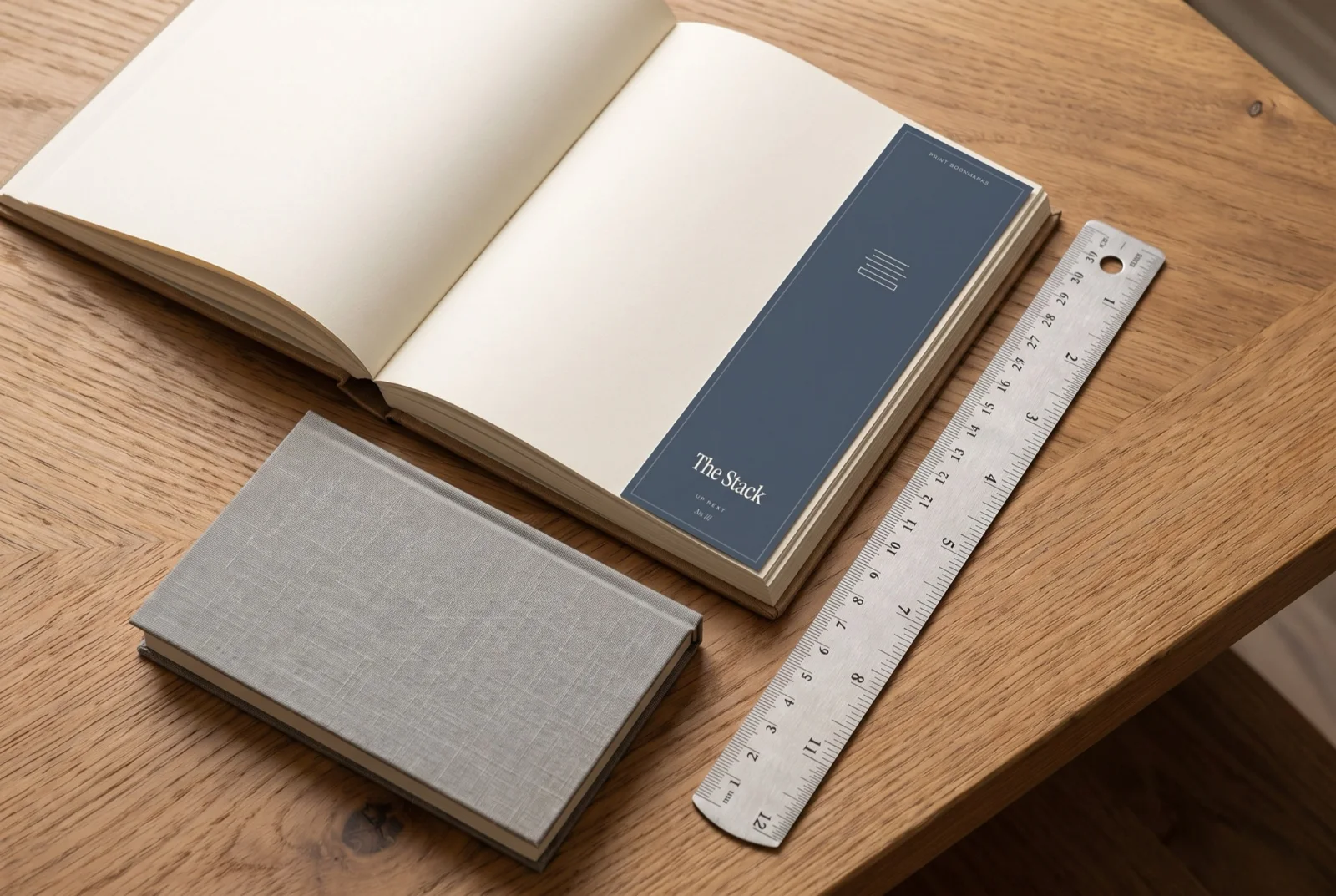
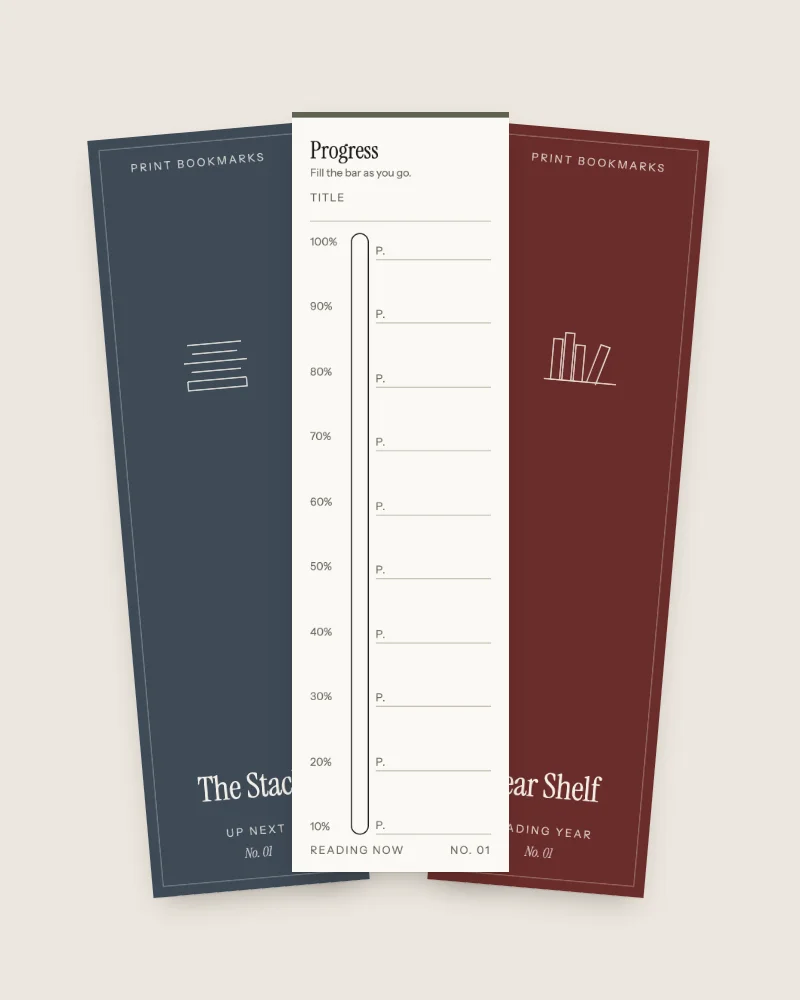
The standard bookmark size is about 2 inches wide and 7 to 8 inches long, and our free printable bookmarks use the shorter end of that, 2 by 7 inches. Nobody sets the size officially. It comes from the page height of a paperback, so the length changes when your books are shorter than a novel, as a pocket paperback is, or when you draw the design yourself in pixels.
What is the standard bookmark size?
Most printed bookmarks are 2 to 2.5 inches wide and 7 to 8.5 inches long, and 2 by 7 inches is the size you meet most often. No standards body defines a bookmark. The handiest references are the library design contests, because each one fixes an exact size for entries.
Bradley University's Cullom-Davis Library asks for a strip 2 inches wide and 7 inches long. Wake County Public Libraries and the Manhattan Public Library in Kansas both use a 2 by 8 inch frame. The South Carolina Association of School Librarians goes wider, at 2.5 by 8 inches.
In metric, 2 by 7 inches is 50.8 by 177.8 mm, and 2 by 8 inches is 50.8 by 203.2 mm. NIST lists the inch as exactly 25.4 mm, so any size converts by multiplying. When a craft pattern calls for a strip of about 5 by 18 cm, that is the 2 by 7 inch bookmark under another name.
Why 2 by 7 inches?
Because a 7-inch strip stays inside every regular paperback. Page height sets the length. Keep the top of the bookmark at least a quarter inch below the top edge of the page. That gap keeps the strip hidden when it slides a little, and enough still shows at the bottom to pull it out. The Toronto Public Library puts most paperbacks between 5 by 8 and 6 by 9 inches. The shortest of those is 8 inches tall, which a 7-inch bookmark clears by an inch.
The job sets the width, and the book has little say in it. Two inches is enough to mark a page, to hold a reading log ruled in half-inch rows, or to carry a name and a short quote. Artwork and longer quotes get more room at 2.5 inches.
For a plain page marker, cut a 2 by 7 inch strip from any card in the house. Our free printable bookmarks use that same strip, four to a sheet with cut marks, so they suit any regular paperback and stand out above a pocket book. If you would rather draw your own, there are ideas for what to put on the strip, from a word list to a pressed flower.
Will it fit a mass-market paperback?
Fit depends on the page height, and the small rack-size paperbacks are the books where a 7-inch strip tends to show. The quarter-inch rule gives you the line. Any page under 7.25 inches tall leaves part of a 7-inch strip above the edge. An A6 pocket book is the clearest case. The University of Cambridge page on ISO paper sizes gives A6 as 105 by 148 mm, which is 5.83 inches tall, so a standard bookmark stands more than an inch proud of it.
For those books, cut a 2 by 5.5 inch strip from cardstock, or trim an inch and a half off the bottom of a printed one. A printed 2 by 7 inch bookmark is the wrong choice for a pocket book unless you cut it down. When you cut your own, which cardstock weight to use matters more than the design. Measure the page from top edge to bottom edge, take off a quarter inch, and round down to the nearest half inch.
| Book | Page height | A 2 by 7 inch strip | Longest strip that stays inside |
|---|---|---|---|
| A6 pocket book, 105 by 148 mm | 5.83 in | Shows by more than an inch | 2 by 5.5 in |
| Pocket paperback, measured under 7.25 in | under 7.25 in | Shows | page height less a quarter inch |
| 5.06 by 7.81 in paperback | 7.81 in | Fits, 0.81 in below the top | 2 by 7 in |
| 5 by 8 in paperback | 8 in | Fits, 1 in below the top | 2 by 7 in |
| A5 book, 148 by 210 mm | 8.27 in | Fits | 2 by 8 in |
| 5.5 by 8.5 in paperback | 8.5 in | Fits | 2 by 8 in |
| 6 by 9 in paperback | 9 in | Fits, 2 in below the top | 2.5 by 8.5 in |
What about a child's picture book?
Any of the common sizes fits inside a picture book, so the question turns into whether a 4-year-old can find the bookmark again. A picture book takes one or two sittings, and a strip buried between tall pages is easy to lose. Let the bookmark show. A 2 by 8 inch strip puts a tab above the pages of most picture books. A ribbon or a tassel tied through a hole near the top gives a hidden strip a handle that a small hand can grab.
Card that sticks out takes every knock at its top corners, and those corners soften after a few weeks in a book bag. A corner bookmark folded from a 6-inch square of paper avoids that. It grips the page corner and sits flat under the cover, and a 5-year-old can fold one after watching once. Punching the hole for a ribbon is a job for an adult, and so is cutting the strip from cardstock.
Does the size change on A4 instead of US Letter?
The bookmark stays the same, and only the sheet around it changes. US Letter measures 216 by 279 mm and A4 measures 210 by 297 mm. The Cambridge page puts it in one line: "ISO A4 is 6 mm less wide but 18 mm higher than the U.S. 'Letter' format." A 7-inch strip, 177.8 mm, stands upright on either sheet with room above and below for margins.
Width is where A4 gets tight. Four 2-inch strips side by side take 203.2 mm. That leaves 12.7 mm across a Letter sheet and only 6.8 mm across A4, too little for the margins most printers need. Our A4 sheets cut each bookmark 50 mm wide instead of 50.8 mm, so four strips take 200 mm and leave 10 mm. The difference is less than a millimeter per bookmark.
What does matter on either sheet is the scale setting. Choose 100% and print at actual size every time, because "fit to page" shrinks the whole sheet and the strips come out shorter than 7 inches.
How many pixels for a design file?
Multiply each inch by 300. The University Press of Colorado's art guidelines ask for at least 300 pixels per inch at the final printed size. A 2 by 7 inch bookmark is then 600 by 2,100 pixels, 2 by 8 inches is 600 by 2,400 and 2.5 by 8 inches is 750 by 2,400. Divide pixels by inches to check a file, and 1,200 pixels across 4 inches gives 300. Raising the DPI number on a small image adds no detail, so start from a photo or scan that already has the pixels.
If all you need is a name, a quote or a photo at the standard size, the bookmark maker lays four out at 2 by 7 inches with cut marks and no pixel math. It cannot change the size. A 5.5-inch strip for a pocket book or a 2.5-inch-wide art bookmark needs your own file.
For that file, add an eighth of an inch of bleed on every side when color runs to the edge. A slightly crooked cut then lands in color instead of leaving a white sliver. Keep text and ruled lines an eighth of an inch inside the cut line for the same reason. At 300 pixels per inch, the 2 by 7 inch canvas becomes 675 by 2,175 pixels. The cut line sits about 38 pixels in from each edge, and the text safe zone another 38 pixels inside that.
Sources
- Bradley University Cullom-Davis Library, Bookmark Contest (2026) (last checked 2026-10-02)
- Wake County, Wake Libraries Kick Off Second Annual Bookmark Design Contest (2026) (last checked 2026-10-02)
- Manhattan Public Library, 2026 Bookmark Contest (2026) (last checked 2026-10-02)
- South Carolina Association of School Librarians, Book Award Bookmark (2026) (last checked 2026-10-02)
- NIST, SI Units: Length (2025) (last checked 2026-10-02)
- Toronto Public Library, Choosing Your Book Size for Asquith Press (2016) (last checked 2026-10-13)
- University Press of Colorado, Digital Art Guidelines (n.d.) (last checked 2026-10-13)
- University of Cambridge, A4 Paper Format and International Standard Paper Sizes (2025) (last checked 2026-10-02)