Reading Journal Template: A Step-by-Step Guide
Blank pages are the hardest part of a new journal, because you have to decide what each one is for. A reading journal template is a short set of page layouts that settles that in advance. Five cover almost everything, a book page, a year at a glance, a to-be-read page, a series tracker and a quotes page. Draw the pages by hand or print your own, then bind them in a binder or on discs.
What Pages Does a Reading Journal Template Need?
A reading journal needs five page layouts in all. Each answers a single question. Our guide to starting a reading journal covers what to record and how to keep the habit going.
| Page | The question it answers | How often you fill it |
|---|---|---|
| Book page | What did I think of this book? | Twice per book, at the first and last page |
| Year at a glance | What have I read, and when? | Once per finished book |
| To-be-read page | What do I read next? | Whenever a recommendation arrives |
| Series tracker | Which book comes next in this series? | Once per series, then tick as you go |
| Quotes page | Which lines do I want to keep? | Whenever a line stops you |
Step 1: Lay Out the Book Page
The book page is split into four zones, so you always know where a note goes. A narrow strip at the top holds the facts, the middle holds your reaction, a few lines below it hold quotes and the bottom holds the verdict. Keeping the same positions on every page lets you compare books at a glance.
| Zone | Space it needs | What goes in it |
|---|---|---|
| Top strip | Two to three lines | Title, author, dates and a five-star rating |
| Middle | A box of four to six lines | One sentence on what the book is about, then what you felt |
| Lines to keep | Three lines with a page column | Quotes you want to find again |
| Bottom | One ruled line | Your verdict in a single sentence |
As a planning example, not a rule, give each book one page. Twelve books then take twelve pages, and a year page, a to-be-read page, a quotes page and a cover add four more. Pew Research Center's October 2025 survey found that 14% of U.S. adults read more than 20 books in a year, so leave spare pages if you are one of them.
Leave a few blank lines beside each book for the entries that grow. A book that moved you can spill onto the next page, and a forgettable one needs only the strip and the verdict.
Step 2: Add a Year-at-a-Glance Page
A year at a glance gives every month a small box and lets you see your reading as a shape. Draw twelve boxes in a grid, three across and four down, and write each finished title in its month. The page answers what you read in March without any flipping.
A shelf works as well as a grid. Draw a row of spines for each month and color one in per book, wide for a long book and narrow for a short one. The page fills with color as the year goes by.
Step 3: Add a To-Be-Read Page
The to-be-read page is a short list with a reason beside each title. Split it into three columns for books you own, books at the library and books on your wish list. Our guide to making a TBR list shows how to prune it and where to start.
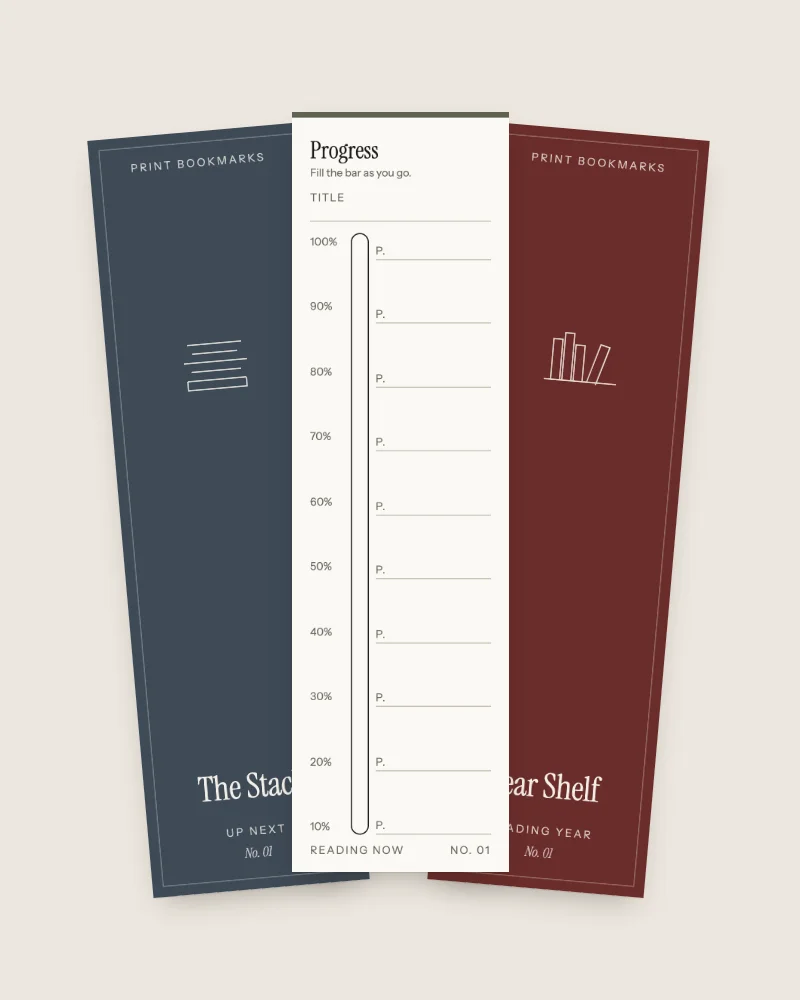
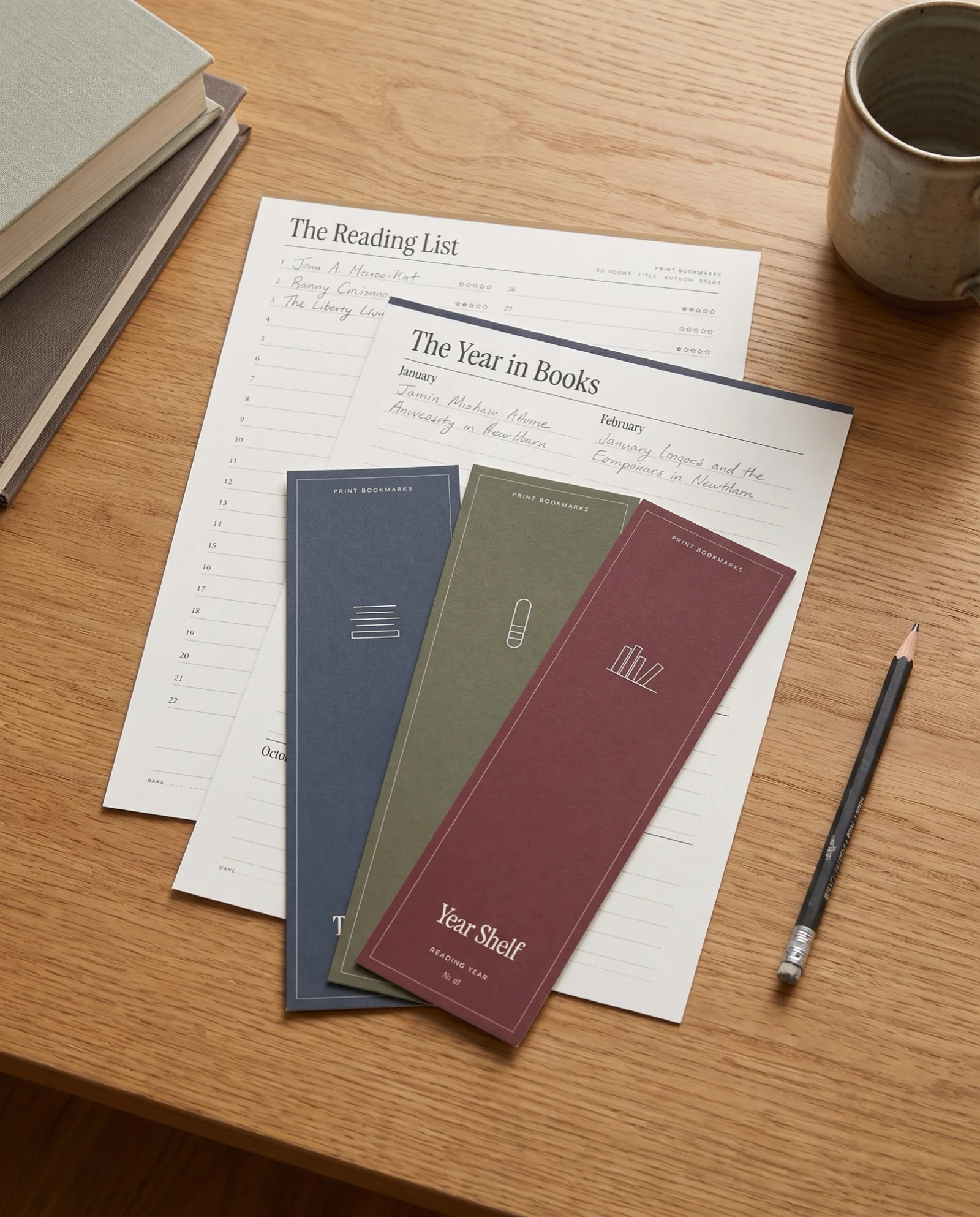
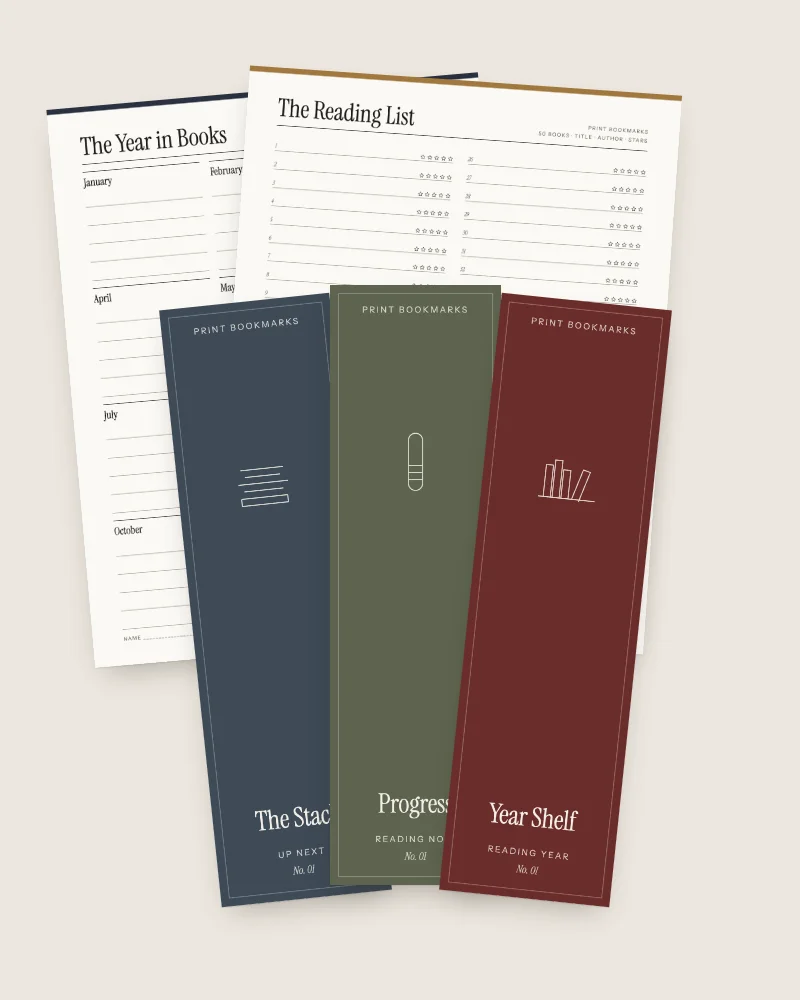
Ready-made versions of these pages exist. The Complete Bundle holds The Year in Books, with twelve months and five books each, The TBR Shelf, with five shelves of empty spines, and The Reading List, with fifty numbered lines. Each is one full sheet in US Letter and A4, so you can punch them like any other page and bind them in.
Step 4: Add a Series Tracker Page
A series tracker answers which book comes next. Write the series name at the top, then number each title in reading order down the left side. Add a tick box at the right and a short line for the date.
Give each series a half page, or one full page if it runs long. Put the next title in a different color so your eye finds it first. Series with spin-offs are easier to follow when you list the extra books in italics under the main numbers.
Step 5: Add a Cover and a Quotes Page
A cover makes the loose pages feel like one object. Write your name, the year and a line such as "If found, please return" in the middle of a plain sheet. Add a small drawing of a bookshelf if you like.
A quotes page is a plain ruled sheet with a narrow column down the left for page numbers. Write the line first, then the book's title in the margin. A page like that reads as a list of the writing that mattered to you.
Step 6: Print the Pages and Bind Them
Print your layouts at actual size on plain or matte paper around 120 gsm, then bind them so pages can move. Some pens bleed through, so test yours on the back of a spare page. For pages printed on both sides, print one test page on plain paper first and flip it on the long edge to check the back lines up. Our sheets come as US Letter and A4 PDFs, and A5 applies only to a notebook you set up yourself. Most readers choose one of two systems, a binder with rings or a disc-bound cover. Both let you add a book page at the back and slide a year page to the front.
The standard North American three-hole pattern puts the holes 4.25 inches apart, center to center, according to the MyBinding guide to hole punches. A University of Cambridge page on international paper sizes gives the same pattern as the 108-mm filing system widely used in the U.S. It adds that the ISO filing standard uses two holes 80 mm apart, so match your punch to your binder.
Disc binding works differently. Levenger, which sells a disc system called Circa, says mushroom-punched sheets click onto discs so you can add, remove and reorder pages. Those pages need the matching hole shape, so check how you will punch them before you buy discs.
Pro Tip: Punch a whole stack of blank pages before you rule or print on them. The holes line up from sheet to sheet when you push each one against the same punch guide.
| Page size | Measures | Good fit for |
|---|---|---|
| US Letter | 216 by 279 mm (8.5 by 11 in) | A three-ring binder, with room for tables and a full shelf |
| A4 | 210 by 297 mm, 6 mm narrower and 18 mm taller than Letter | A4 binders and readers outside the U.S. |
| A5 | 148 by 210 mm, half of A4 | A small notebook you set up yourself, since our sheets come as US Letter and A4 |
Key Takeaway: A reading journal is five page layouts on punched pages. Match the page size and hole pattern to your binder, and the pages will go in without trimming.
When Loose Pages Are the Wrong Choice
A set of loose pages is the wrong choice if you want a finished book on the shelf. Binders add bulk, and discs need a punch. A bound notebook with a stitched spine is lighter and easier to carry. You rule the pages yourself. The Complete Bundle gives you sheets and bookmarks, not a bound book.
Overview of the Six Steps
| Step | What you do | What you end up with |
|---|---|---|
| 1 | Lay out the book page in four zones | A page where every note has a place |
| 2 | Add a year-at-a-glance page | Your year as one picture |
| 3 | Add a to-be-read page | A next book you can name |
| 4 | Add a series tracker | The right book in the right order |
| 5 | Add a cover and a quotes page | A journal that feels like yours |
| 6 | Print and bind the pages | Pages you can add, remove and reorder |
FAQ
What pages should a reading journal have?
Five layouts cover most readers. They are a book page for facts and thoughts, a year at a glance, a to-be-read page, a series tracker and a quotes page. A cover is a nice extra.
What is a good reading journal tracker?
A good tracker answers one question at a glance. A series tracker lists each title in order with a tick box. A year at a glance shows what you read in each month.
How do I bind printed journal pages?
Punch the pages and put them in a ring binder, which in North America means three holes 4.25 inches apart. Or use a disc-bound cover, which needs pages punched with a mushroom-shaped hole pattern.
What do I get with The Complete Bundle, and can I print it again?
You get a zip for each set and list with a US Letter PDF, an A4 PDF and a README, and a receipt email brings the download link right after payment. Print at actual size (100%) on any home inkjet or laser. Reading lists print on plain or matte paper around 120 gsm and bookmarks on matte card of about 176 gsm (65 lb cover). You may print as often as you like for you and your household, and give printed bookmarks or sheets as gifts. Please do not share or resell the file.
Conclusion
A reading journal comes together faster when each page has a job. Lay out a book page, a year at a glance, a to-be-read page, a series tracker and a quotes page, then bind them in a binder or on discs that suit your paper. Pick the page size first and everything else follows, then rule your first book page tonight.
Sources
- Pew Research Center, Americans still opt for print books over digital or audio versions; few are in book clubs (2026) (last checked 2026-10-05)
- MyBinding, How to choose a three-hole punch for your paper volume (n.d.) (last checked 2026-10-05)
- University of Cambridge, International standard paper sizes (n.d.) (last checked 2026-10-05)
- Levenger, Composition vs bound vs spiral vs ring binder vs discbound (n.d.) (last checked 2026-10-05)