Mandala Meaning: What Does a Mandala Stand For?
The word mandala means a circle with a center, which is how the Rubin Museum of Art defines it. In Buddhist practice the meaning of a mandala goes much further: the design, usually a square inside a circle, is the dwelling of a deity and a picture of the whole universe, used in meditation and ritual. The round patterns in coloring books borrow the shape and leave the religious content behind.
The word and the shape
The word mandala means a circle with a center, as the Rubin Museum of Art puts it. That short definition covers every mandala you will meet, from a Tibetan painting to a page in a coloring book. There is one point in the middle and a round boundary around it.
In Buddhist art the shape is more exact than a plain ring. The Rubin describes a square set inside a circle, and the pair stands for the universe and for the dwelling of a deity. The museum's glossary says the same thing from the other side, a round design that encloses a square. A mandala does not even have to be flat. It can be painted, or built in three dimensions as a temple or a stupa.
To see the plan in your hands, fold a square of paper in half twice. The creases cross at the center, and the four quarters show how a design grows outward from one point.
Mandala meaning in Buddhist practice
In Vajrayana Buddhism, and in Bon, a mandala is the cosmic abode of a deity, according to the Rubin Museum's glossary. Mandalas are used in initiations and in deity meditation, and they mark out sacred ritual space. They are also offered to the deities as representations of the entire universe. In tantric practice, the Rubin adds, they are aids for meditation and visualization.
The Smithsonian explained the Tibetan form for its Tibetan Healing Mandala exhibition in 2002. A Tibetan mandala, as a picture, is a geometric composition in which deities reside, with the principal deity at the center. The museum calls it a tool toward enlightenment with three layers of meaning. The outer meaning is a model of the universe. The inner meaning is help for the mind on its way to enlightenment, and the secret meaning is a perfect balance of mind and body.
A painted mandala in a museum is a devotional object, much as a stained-glass window is, even for a visitor with no tie to Buddhism. Someone trained in the tradition sees a palace with an occupant where a visitor sees a pattern. That is why museum labels speak of deities residing in the composition, and why respect is the right starting point when you borrow the shape.
The yantra in Hinduism and the mandalas of Japan
Hinduism has a similar concept, the yantra, as the Rubin glossary notes. The Rubin page says no more about it, so a reader interested in Hindu practice should look to a source on the yantra itself.
Mandalas are also part of Buddhism in Japan. A Japanese Mandala of the Womb World in the Smithsonian's collection is a schematic representation of the universe. In place of painted figures it carries seed syllables written in Sanskrit, each one standing for a Buddhist deity. Mandalas of this kind come as a pair, the Womb World and the Diamond World. The museum says the pair was used for esoteric Buddhist ceremonies and for individual devotional practice. Seed-syllable mandalas probably began in Japan around the mid-11th century.
Where and when the first mandalas were made is a question these museum pages do not answer. The mid-11th century date belongs to one Japanese type, so treat any confident origin story you find elsewhere with some care.
The circle and its parts
Read a mandala from the center outward. In a Tibetan composition the center holds the principal deity, so it is the most important point in the design. Everything else is arranged around it. Next comes the square, the dwelling in Buddhist versions, and then the circle that closes the whole.
A coloring page or a hand-drawn design keeps the same order with the religious content gone. The central motif is often a dot or a small flower. Around it run rings, and each ring repeats one unit, a petal, a leaf or a drop. Count the repeats in one ring and you know how the circle was divided. A ring of eight petals means eight equal slices. The next ring usually keeps that number or doubles it, and the repeat is what makes the design look calm.
To draw one yourself you need three circles and a ruler. A cup, a saucer and a plate traced around one center give the rings. A ruler through the center twice, at right angles, gives four slices, and twice more on the diagonals gives eight. Put one petal in each slice of the first ring, then keep going outward.
Mandalas in coloring books today
The mandalas in coloring books keep the shape and drop the religious program. A round pattern with a center and repeating rings is a mandala in the loose, modern sense, and coloring one is not a religious act.
If you want a design with the square palace and the deities, a coloring page, ours included, is the wrong place to look. The museums cited here make no claim that coloring a mandala calms or heals anyone. Weigh such promises on a book cover for yourself.
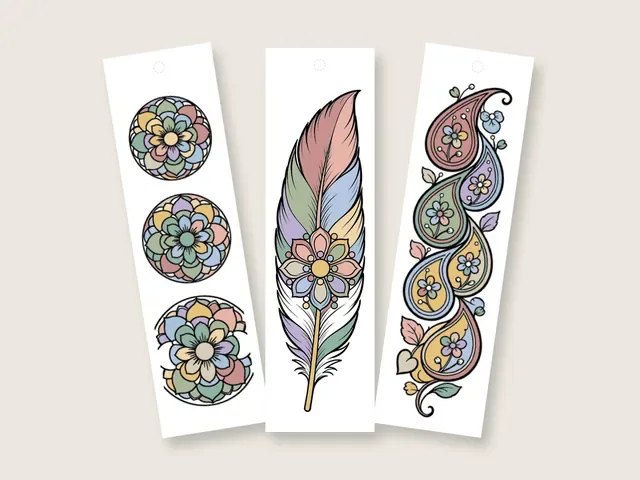
Where do you get one to color? A library coloring book works, and so does a mandala you drew with the plate and cup. Our free mandala coloring pages hold 40 full pages and 40 bookmarks as PDFs for US Letter and A4. Each bookmark is 2 by 7 inches, four to a sheet with cut marks.
The bookmarks keep bold outlines for the narrow strip, and the full pages carry finer detail for a slower project. The page's own coloring advice is to work from the center outward, one ring at a time, with a few colors repeated in every ring.
A colored strip needs only scissors. There are more ways to turn a colored mandala into a bookmark, such as laminating it or tying a tassel through the hole. If you colored a full page, cut a strip from the best part and make a bookmark with card behind it, so it stands up to use.
Explaining a mandala to a child
Tell a 5-year-old that a mandala is a picture that starts from a dot in the middle and grows outward in rings. Ripples in a pond after a stone drops, or a flower seen from above, give the idea.
Then draw one together. Put a dot in the center of a paper plate, draw a ring of petals around it, and let the child add the next ring. Each ring is a turn, so the drawing becomes a game of taking turns, with a petal count before each one.
A child of 8 to 10 can take the next layer. Say that in Buddhism a mandala is a map of the universe and the home of a deity, used in meditation, and that people treat it with the respect any sacred picture gets. The Smithsonian's three layers go into plain words: a picture of the world, a help for the mind, and a picture of balance. Say plainly that the shape can be borrowed for fun, while the religious pictures belong to the people who pray with them.
For a class or a family afternoon, give a child who finds plain circles dull a mandala that is also an animal. Our mandala coloring bookmarks include an owl on a pile of books, a tall elephant and a curled fox. The page suggests those for children who find plain mandalas too abstract. Before any color goes down, have the child count the petals in the first ring and choose the colors for that ring with you.
Questions
What does the word mandala mean?
A mandala is a circle with a center, as the Rubin Museum of Art defines the word. In Buddhist art it usually takes the form of a square inside a circle that stands for the universe and for the dwelling of a deity.
Is a mandala a religious symbol?
In Vajrayana Buddhism and in Bon it is, the cosmic abode of a deity, used in initiations, meditation and ritual, and Hinduism has the similar yantra. A round pattern in a coloring book borrows the shape without that content, so coloring one is not a religious act.
What is the simplest way to explain a mandala to a kid?
Say it is a picture that grows from a dot in the middle, ring by ring, then draw one together on a paper plate with one ring per turn. For a child who would rather color than draw, our free mandala coloring bookmarks keep the outlines bold on a 2 by 7 inch strip.
Sources
- Rubin Museum of Art, Highlights: Mandala (n.d.) (last checked 2026-10-13)
- Rubin Museum of Art, Himalayan Art Resources glossary: Mandala (n.d.) (last checked 2026-10-13)
- Smithsonian Freer and Sackler Galleries, Tibetan Healing Mandala online exhibition FAQ (2002) (last checked 2026-10-13)
- Smithsonian National Museum of Asian Art, Mandala of the Womb World, object F1998.308.4 (n.d.) (last checked 2026-10-13)