How to Write a Book Report in Grades 1 to 8
The report is due Friday, the book is finished, and the child at the table has written the title and stopped. A book report at any grade has the same four parts: the facts about the book, a summary, the people and the place, and an opinion with a reason. This walk-through shows how to write a book report part by part, with what changes between grade 1 and grade 8.
What a teacher expects in grades 1 to 8
Every book report has the same skeleton. It names the book, tells what happens, says who is in it and where, and ends with what the reader thought. The Purdue Online Writing Lab calls it an informative report written from an objective stance, and says book reports are mostly a K-12 assignment. What grows between grade 1 and grade 8 is the number of parts and how much goes under each one.
| Grade band | Parts the report usually asks for | How much writing |
|---|---|---|
| Grades 1 to 2 | Title and author, what the book is about, a favorite character, a favorite part (often drawn), a new word, yes or no to telling a friend | A sentence or two under each prompt, plus a drawing |
| Grades 3 to 5 | Genre, main and other characters, setting, the problem and how it is solved, a favorite part, a rating with reasons, who should read it | Two or three sentences under each prompt, about two pages by hand |
| Grades 6 to 8 | A summary, theme, the type of conflict, how the main character changes, a quote with its page number as evidence, a recommendation | Short paragraphs, 250 to 500 words in total, which Purdue gives as the typical length |
Treat the band as a starting point. A strong 7-year-old can handle the grades 3 to 5 set. An 11-year-old who finds writing hard does better with fewer prompts and bigger lines. If the teacher handed out a form or a rubric, that wins over any table, including this one.
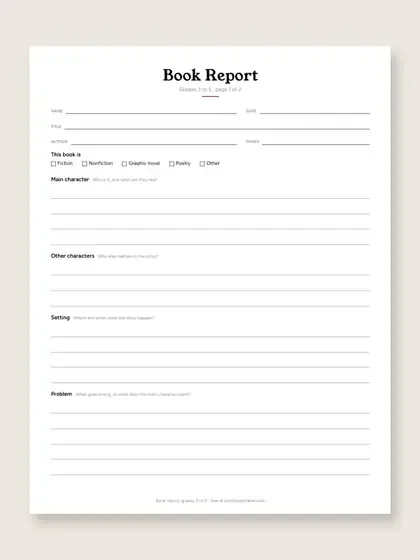
When there is no form, the free Book report template comes in the three bands above. Each is two pages, for US Letter or A4, with a gray hint under every prompt, so a child can work without an adult at the elbow. It is the wrong choice for a project with a chosen format, such as a poster or a letter, and for a kindergartner who dictates. Plain paper and the list of parts in the table serve those better.
The heading: title, author and the facts about the book
Start with the facts, because they are the easiest part and they get the pencil moving. Purdue lists the author, the title, publisher information, the year and the page count. They go either in a citation line at the top or woven into the opening sentences. A 7-year-old needs only the title and the author. A 13-year-old should give all five.
Take them from the title page, since a cover sometimes shortens the title or drops a subtitle. The publisher and year sit on the copyright page right behind it, and the page count is the last numbered page. The most common slip in the whole report is a misspelled author name, which takes ten seconds to check against the spine.
From grade 3, forms add the genre, often as a checkbox for fiction, nonfiction, graphic novel or poetry. Scholastic's guide for ages 11 to 13 goes a step further. Genre there means what kind of story it is, a mystery or historical fiction. Point of view means how it is told, first person or third person. A 10-year-old can settle the point of view by checking whether the narrator says "I" on the first page.
The summary, where most of the book report gets written
Purdue says to make sure that most of the paper summarizes the work. The stance is objective: what happens, in order, without saying yet whether it was any good. In grades 1 and 2 that is one or two sentences on what the book is about. In grades 3 to 5 the summary hides inside three prompts, setting, problem and solution. By grade 6 it is a paragraph or two in the child's own words.
The trap is retelling. A child starts with "First" and after a page is still in chapter 2. Three questions cut it down. Who wants what at the start? What gets in the way? How does it end? One sentence for each, then one more for the event the child remembers best, and a 9-year-old has a finished summary. A 13-year-old grows each answer into a few sentences and keeps the order.
Ask the teacher whether the ending belongs in. Some want the whole plot as proof the book was read. Others want a summary without spoilers, the way the grades 6 to 8 template asks for it, because the report doubles as a recommendation to classmates. When nobody can say, write the ending as a separate last sentence that can be crossed out.
If the child cannot say what got in the way, the gap is in comprehension, and no writing advice fills it. Reread the chapter where the problem appears with that one question in hand. A one-line note each night, the page reached and one thing that happened, is a reading log entry, and a week of them turns into a summary in ten minutes. A book finished three weeks ago with no notes means rereading the first and last chapters.
Characters and setting
Scholastic lists the story elements as the characters, the setting as the where and when of the story, the genre, the point of view and the tone. The younger grades take the first two. A 6-year-old names a favorite character and says one thing about them. A 10-year-old separates the main character from the others and gives the setting in a sentence. A 13-year-old explains how the main character changes.
The mistake with characters is a list of names. Give each one a sentence built the same way: a name, what that person wants, and one thing they do about it. For the main character, add how they feel at the start. Two or three characters are plenty even in a book with twenty. Most forms have lines for a main character and a few others, so the limit is built in.
Setting is where and when, and the test for whether it matters is to move the story. A tale set in a lighthouse in winter would be a different book in a city in July. If moving it changes nothing, one line is enough. If it changes everything, say what the place does to the characters.
For grades 6 to 8, the change in the main character is the part teachers read most closely. Two sentences do it. At the start, this person is or wants one thing. By the last chapter, something is different, and the report names the event that caused it. A 12-year-old who can write those two sentences has done the hard part of the report.
Theme, conflict and a quote as evidence
From grade 6 the report moves from what happened to what the book was about. The theme is one sentence on what the story says about something, such as friendship or being the new kid. The conflict is its type: a character against another person, against nature, against the rules of their world, or against themselves. Tone, which Scholastic adds to the list, is the feeling the writing gives, funny, sad or tense, in one word with a reason.
The quote is the one part that needs the book open. The child copies a line with its page number, then writes a sentence on why that line. That sentence is the one that earns the mark. Pick a line that shows the theme or the change in the main character. One quote with a sentence beats three quotes with none.
A grades 1 to 2 form asks for a lighter version of the same move, one new word from the book, written out and used in a sentence.
Your opinion and who should read it
After the summary, Purdue asks for a brief evaluation. It covers what worked, what did not, how the book compares to others in its genre or by the same author, and whether you would recommend it. In grades 1 and 2 that is a face to color and a yes or no to telling a friend. In grades 3 to 5 it is a star rating with reasons and who to recommend the book to. In grades 6 to 8 it is a short paragraph with reasons.
"It was good" is where most reports stall. The rule is that every opinion gets a because. If the child cannot find one, ask about the part they read fastest and the part they wanted to skip. When a child writes one sentence and stops, prompts that get a child writing help more than a second request to write more. A recommendation should name a reader, such as a 9-year-old who likes animals and does not mind a sad ending, since "everyone" tells the teacher nothing.
A 13-year-old writing for a book club or for their own shelf can use the one-page book review template instead. It has a one-sentence verdict, a quote with its page number, and two columns for what worked and what did not. For a graded report it is the wrong choice, because it has no summary section.
Book report ideas when the format is open
Some teachers let the class choose the form, and a child who groans at two pages of prompts often writes more in disguise. Each of these still needs the four parts somewhere. Check for the facts, the summary, the characters and an opinion before calling it done.
- A letter to the author, with the opinion and its reasons as the middle paragraph
- A diary entry by the main character for the chapter where the problem starts
- A new front and back cover, where the blurb is the summary and the back-cover quote is the recommendation
- A two-minute book talk, timed, with the ending left out
- A map of the setting with the five main events marked where they happen
- An interview with a character, six questions and six answers
- A comic strip of the problem and the solution in eight panels
The cover and the map suit a 7-year-old. The letter and the interview suit grades 3 to 5. The book talk and the diary entry ask for the voice and the inference that grades 6 to 8 practice. A printed template is the wrong tool for all of these.
Checking the finished report
The check takes about ten minutes. The child should do it with the adult asking the questions, since a 9-year-old who finds their own missing word fixes the next one alone.
- Title and author match the title page, letter for letter
- The summary runs in order, in the child's words, with nothing copied from the blurb
- Every opinion has a because after it
- Every part the grade asks for is there, including the quote and page number from grade 6 on
- Name and date are on the page
- The child reads it aloud once, because a missing word is heard before it is seen
The adult's job is the questions, never the pencil. A report that sounds like a 7-year-old is what the teacher of 7-year-olds expects to read, and one that sounds like a parent gets handed back. Then it goes into the folder the night before, with the book, in case the teacher asks for the page number.
Sources
- Purdue Online Writing Lab, Writing a Book Report (n.d.) (last checked 2026-10-13)
- Scholastic Parents, Create a First-Rate Book Report (2021) (last checked 2026-10-13)